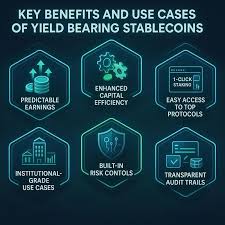
Institutions in 2025 are deploying sophisticated yield-tracking systems to monitor stablecoin performance across DeFi and custodial platforms.
Why Yield Tracking Matters
For decades, corporate treasuries and hedge funds tracked bond yields and money market rates. In 2025, they apply the same rigor to stablecoin yield tracking. With billions allocated to lending pools, automated market makers (AMMs), and tokenized treasury products, institutions need precise analytics to measure, compare, and forecast returns.
Stablecoin yield tracking is no longer a back-office task it is a board-level requirement.
Core Elements of Yield Tracking
Real-Time Return Data
Dashboards calculate annualized yields across lending pools, AMMs, and custodial accounts.
Risk-Adjusted Yields
Systems evaluate returns in relation to volatility, liquidity depth, and counterparty risk.
Cross-Chain Comparisons
Institutions track yields across Ethereum, Solana, and Layer-2 networks.
Compliance Integration
Reports include AML filters to ensure yield sources are regulator-approved.
Institutional Applications
Hedge Funds: Use yield tracking to rotate capital between pools offering the best risk-adjusted returns.
Corporate Treasuries: Deploy conservative yield models to maximize cash efficiency while minimizing risk.
Custodians: Provide clients with yield performance dashboards as part of custody services.
Regulators: Request yield data to evaluate whether returns align with compliance standards.
Expert Commentary
Dr. Laura Mitchell, Senior Analyst at OnChain Metrics:
“Yield tracking transforms DeFi from speculation into structured finance. Institutions cannot operate without it.”
Michael Carter, Head of Digital Assets at Apex Bank:
“We measure stablecoin yields with the same rigor we apply to bonds. Transparency and comparability are essential.”
Case Studies
New York Hedge Fund: Shifted $750 million from AMMs to lending pools after dashboards flagged higher adjusted yields.
European Corporate: Deployed stablecoins into tokenized treasury products, monitored daily via integrated yield trackers.
Tools for Yield Tracking
On-chain dashboards calculating real-time APRs across pools.
AI-driven engines forecasting yield changes under stress conditions.
Cross-market comparators enabling global benchmarking.
Role of Artificial Intelligence
AI enhances yield tracking by:
Predicting shifts in DeFi yields based on whale movements.
Identifying unsustainable high-yield pools.
Automating rotation strategies for treasuries and funds.
Reducing human error in risk-return calculations.
The Bottom Line
Yield tracking is the bridge between institutional caution and DeFi opportunity. In 2025, it ensures that stablecoin allocations deliver sustainable, compliant returns. For institutions, dashboards are no longer optional they are the foundation of yield-driven strategy.