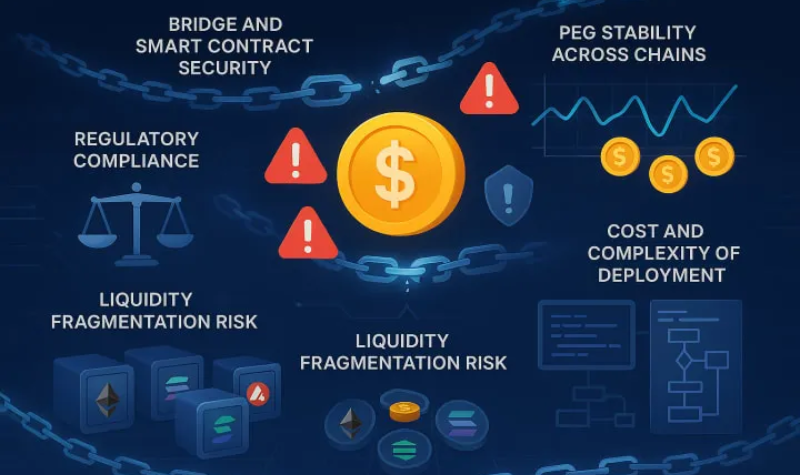
Stablecoins have become an essential component of institutional finance, providing predictable value, operational efficiency, and seamless integration across global platforms. As institutional adoption grows, understanding and managing risk associated with stablecoins is critical. Effective risk assessment frameworks enable institutions to evaluate liquidity, counterparty exposure, peg stability, and operational risks, ensuring safe deployment and maximizing capital efficiency.
The Importance of Risk Assessment in Stablecoin Deployment
Institutional participants hold large volumes of stablecoins, which are frequently used for treasury operations, cross-border payments, lending, and participation in decentralized finance (DeFi). Even though stablecoins are pegged to fiat currencies, several risk factors can impact operational efficiency and financial stability:
-
Liquidity Risk: The ability to access stablecoins quickly can be challenged during sudden redemption surges or network congestion.
-
Counterparty Risk: Exchanges, lending platforms, custodians, and bridges may fail to fulfill obligations, potentially delaying settlements or restricting access to funds.
-
Interest Rate and Yield Volatility: Yield from lending, staking, or liquidity pools can fluctuate depending on borrowing demand, platform utilization, and market conditions.
-
Operational and Smart Contract Risk: Cross-chain transfers, bridges, and decentralized platforms introduce technical and operational vulnerabilities.
-
Regulatory and Compliance Risk: Jurisdictional regulations, AML/KYC rules, and reporting obligations must be adhered to, particularly for global transactions.
Key Components of Institutional Risk Assessment Frameworks
-
Liquidity Analysis: Institutions evaluate reserve levels, pool utilization, and cross-chain access to ensure operational liquidity. Predictive models can forecast periods of high redemption demand or network congestion.
-
Counterparty Evaluation: All exchanges, lending platforms, and custodians are assessed for financial stability, governance practices, reserve verification, and historical performance. Regular audits and reviews reduce exposure to platform defaults.
-
Peg Stability Monitoring: Institutions track stablecoin peg behavior across networks and platforms to anticipate deviations and adjust allocations proactively.
-
Operational Risk Assessment: Smart contracts, bridges, and cross-chain transfers are regularly audited. Automated monitoring systems detect anomalies, ensuring operational continuity.
-
Regulatory Compliance Review: Institutions integrate jurisdictional rules into operational processes, ensuring AML/KYC adherence and transparent reporting for cross-border stablecoin deployments.
Implementation of a Risk Assessment Framework
-
Define Risk Categories: Identify key risk areas, including liquidity, counterparty, operational, regulatory, and market risks.
-
Develop Metrics and Thresholds: Establish KPIs such as reserve sufficiency, pool utilization, counterparty reliability scores, and peg deviation limits.
-
Monitoring and Analytics: Implement dashboards and automated alerts to track real-time data on liquidity, smart contract health, and network conditions.
-
Scenario Planning and Stress Testing: Simulate redemption surges, network congestion, interest rate spikes, and counterparty failures to evaluate institutional readiness.
-
Governance and Reporting: Document policies, review performance regularly, and engage in platform governance to mitigate potential protocol-level risks.
Case Studies in 2025
A multinational treasury managing USDC, USDT, and DAI developed a risk assessment framework integrating liquidity monitoring, cross-chain deployment, and predictive analytics. During a period of high cross-border transaction activity, predictive models forecasted a spike in redemptions. The treasury proactively allocated liquidity across platforms, ensuring operational continuity and preserving peg stability.
A hedge fund using DAI in multiple DeFi lending protocols implemented automated dashboards to monitor pool utilization, smart contract health, and interest rate trends. When one platform announced temporary withdrawal restrictions, the fund immediately redeployed capital to alternate pools, maintaining consistent yield and mitigating operational disruption.
An institutional custodian developed a comprehensive risk scoring system for all counterparties. By integrating attestation reports, reserve verification, and historical reliability, the custodian minimized counterparty exposure while optimizing stablecoin allocation for treasury and lending operations.
Best Practices for Institutional Risk Assessment
-
Holistic Risk Categorization: Include liquidity, counterparty, operational, regulatory, and market risks.
-
Quantitative Metrics: Establish measurable thresholds for liquidity, yield, and counterparty reliability.
-
Real-Time Monitoring: Utilize automated dashboards and alerts for immediate response to emerging risks.
-
Stress Testing and Scenario Analysis: Evaluate operational readiness under extreme market or network conditions.
-
Reserve Verification: Prioritize stablecoins with transparent, fully backed reserves.
-
Governance Engagement: Participate in protocol governance to influence interest rate models, collateral requirements, and operational policies.
-
Regular Review and Reporting: Continually assess performance, update thresholds, and report outcomes to treasury and compliance teams.
Benefits of a Robust Risk Assessment Framework
-
Operational Continuity: Institutions can maintain treasury, lending, and payment functions reliably even during stressful conditions.
-
Capital Preservation: Reduces exposure to counterparty failures, operational interruptions, and liquidity bottlenecks.
-
Predictable Yield: Ensures participation in yield-generating strategies is efficient and consistent.
-
Regulatory Compliance: Facilitates adherence to jurisdictional requirements, reducing legal and operational risk.
-
Strategic Decision-Making: Data-driven insights from risk frameworks enable institutions to optimize allocation, maximize returns, and respond proactively to market dynamics.
Future Outlook
In 2025 and beyond, institutional adoption of stablecoins will continue to grow, making risk assessment frameworks essential for treasury and investment operations. Predictive analytics, automated monitoring, and cross-chain liquidity management will become standard practices. Institutions that integrate comprehensive risk assessment strategies will enhance operational resilience, safeguard capital, and maximize returns.
By implementing structured frameworks, institutions can confidently deploy stablecoins, maintain operational continuity, and achieve strategic financial objectives. Effective risk management strengthens confidence in stablecoin ecosystems, supporting sustainable growth and adoption across global institutional networks.
In conclusion, institutional risk assessment frameworks are critical for stablecoin management. By analyzing liquidity, counterparty exposure, operational factors, and regulatory compliance, institutions can mitigate risk while maximizing yield and operational efficiency. Structured frameworks empower treasury teams to make informed, proactive decisions, ensuring stablecoins remain a reliable and productive tool in institutional finance.