Introduction
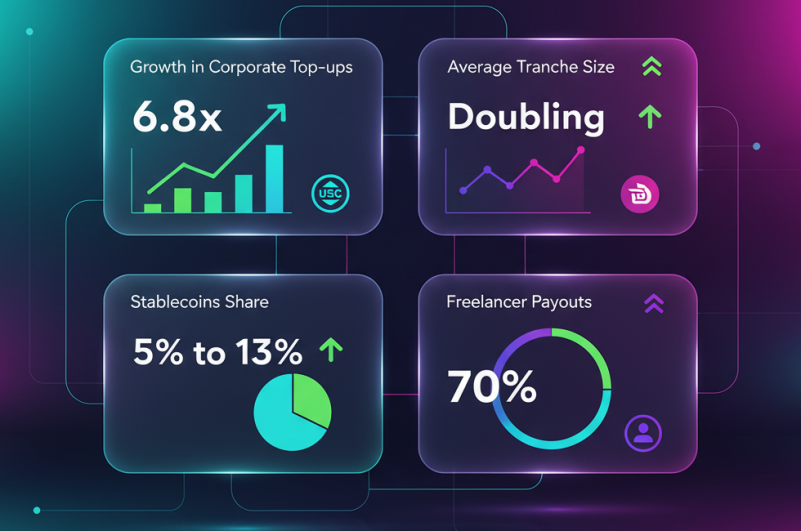
EasyStaff has released new data indicating a 6.8-fold increase in payroll payments using stablecoins, highlighting the growing adoption of digital assets in corporate finance and treasury operations. The trend demonstrates that institutions are increasingly leveraging stablecoins for operational efficiency, cross-border settlements, and employee compensation in both centralized and decentralized ecosystems.
Payroll Adoption Insights
The report shows that companies across multiple sectors are integrating stablecoins such as USDC and USDT into payroll systems. Stablecoins offer near-instant settlements, lower transaction costs, and predictability compared to traditional fiat transfers, making them an attractive solution for businesses with remote or international workforces.
While USDC and USDT dominate corporate adoption, the data also reveals minor shifts in regional stablecoins, reflecting localized demand patterns. These insights allow institutions to evaluate alternative stablecoins for payroll and operational liquidity purposes without compromising transparency or compliance standards.
Institutional and Operational Implications
Corporate treasuries benefit from stablecoin payroll integration in several ways:
-
Reduced Settlement Times: Employees receive funds almost immediately, improving cash flow and satisfaction.
-
Operational Efficiency: Automated transfers minimize manual reconciliation and reduce administrative overhead.
-
Cost Optimization: Lower transaction fees compared to traditional banking channels enable more efficient payroll management, especially for cross-border payments.
Stablecoins also provide transparent transaction records, supporting internal auditing, compliance monitoring, and regulatory reporting. Institutions can track disbursements and maintain a verifiable ledger, ensuring adherence to AML/KYC regulations and corporate governance standards.
Market and Strategic Significance
The EasyStaff report indicates a broader trend of institutional adoption of digital assets beyond trading and treasury operations. Corporate treasuries are now exploring stablecoins for payroll, supplier payments, and liquidity management, reflecting increasing confidence in their operational reliability.
The surge in payroll usage highlights the growing integration of stablecoins into everyday corporate finance workflows. Institutional adoption of digital assets not only enhances efficiency but also positions organizations to participate in emerging DeFi ecosystems, offering potential avenues for yield generation and liquidity optimization.
Conclusion
EasyStaff’s findings confirm that stablecoins are becoming a critical component of corporate financial operations. With a 6.8× increase in payroll adoption, institutions are recognizing the advantages of speed, transparency, and cost efficiency offered by digital assets. As stablecoins continue to gain traction in corporate finance, institutional participants can leverage these tools for payroll, treasury operations, cross-border payments, and strategic liquidity management.