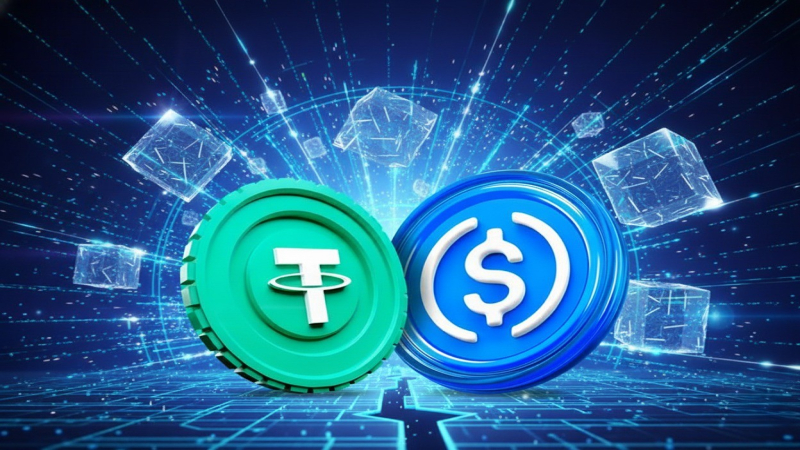
The competition between USDC and USDT has emerged as one of the most defining developments in the digital asset market. As the world’s largest dollar-pegged stablecoins, they have become essential tools for trading, cross-border payments, and liquidity management. Their rapid growth reflects how traditional finance and blockchain ecosystems are converging into a new, integrated financial network.
Institutional adoption of stablecoins has grown rapidly in the past year. Higher interest rates, increased regulatory attention, and demand for faster settlement systems have pushed corporations and funds to explore digital dollars as part of their treasury operations. USDT still leads in total circulation, while USDC has established itself as the preferred option for regulated institutions. The race between the two now represents a deeper competition between scale and compliance.
Stablecoin Liquidity Expansion
USDT remains the dominant stablecoin in terms of supply and trading volume. It is deeply embedded in exchange liquidity, serving as the base currency for most crypto pairs worldwide. Its wide reach allows it to facilitate billions in daily transactions across both centralized and decentralized platforms. For traders and exchanges, USDT’s unmatched liquidity makes it a vital instrument for market operations.
USDC, issued by Circle, has followed a different strategy. Its foundation is built on transparency, full reserve backing, and collaboration with regulated banking partners. Every USDC token is backed by cash or short-term U.S. Treasuries, and the issuer provides monthly attestations verified by independent auditors. This openness has made it attractive for financial institutions seeking reliable, compliant exposure to blockchain-based assets.
The difference in strategy defines how each stablecoin appeals to different segments of the market. USDT’s strength lies in speed and ubiquity, while USDC’s credibility comes from its regulatory alignment and banking partnerships. As institutional investors look for stability, the balance between liquidity access and compliance assurance is shaping the future of digital dollar adoption.
Institutional Integration and Adoption
The past year has marked a clear shift toward stablecoin integration across mainstream financial systems. Payment processors, fintech companies, and banks are incorporating digital dollar settlements into their services. Circle’s partnerships with global financial firms have expanded USDC’s presence in cross-border transactions, remittances, and tokenized asset settlements.
USDT’s integration is broader across the trading ecosystem. It dominates exchange settlements, decentralized finance platforms, and offshore liquidity pools. In emerging markets, USDT serves as a digital dollar substitute where access to traditional banking is limited. It offers fast and reliable transfers for both retail users and institutional traders, giving it an advantage in regions with volatile currencies.
Institutional investors are now experimenting with using stablecoins as an operational layer for settlements and portfolio rebalancing. Asset managers, hedge funds, and even governments are exploring tokenized finance models that rely on stablecoins for near-instant clearing and collateral transfers. This evolution shows that stablecoins have moved far beyond speculative use and are now becoming essential to modern financial infrastructure.
Regulation and Transparency
The regulatory landscape is evolving rapidly and remains a key factor influencing stablecoin adoption. Policymakers in the United States, the European Union, and Asia are introducing frameworks that define reserve quality, redemption rights, and licensing standards for issuers. These changes aim to strengthen transparency and protect investors while supporting financial innovation.
USDC’s regulatory-first approach positions it well in this environment. Circle actively collaborates with regulators and publishes detailed reports on its reserves. Its reserves are fully held in U.S. regulated financial institutions and are subject to rigorous compliance oversight. This consistency has made it a trusted choice for corporate treasuries and institutional funds requiring verified asset backing.
USDT takes a different approach, operating under multiple jurisdictions and catering to a broader international audience. It has worked to improve transparency by publishing periodic attestations of its reserve composition. Despite occasional skepticism, USDT continues to maintain redemption stability and market leadership. The company’s focus on liquidity and availability across regions has ensured its resilience during periods of volatility.
As regulation matures, both stablecoins are expected to align more closely with official financial standards. Enhanced oversight could lead to stronger investor protections and greater confidence in digital assets. The next stage of competition will likely focus on how each issuer adapts to compliance requirements while maintaining efficiency and market coverage.
Institutional Liquidity Dynamics
The increasing participation of financial institutions has changed the structure of stablecoin liquidity. Banks and asset managers are using USDC and USDT to move funds between exchanges, counterparties, and on-chain settlements without relying on traditional clearing systems. This integration has reduced transaction friction and shortened settlement cycles from days to seconds.
Liquidity providers and market makers now hold stablecoin reserves to maintain trading flexibility. USDT’s deep liquidity pools provide unmatched trading volume, while USDC’s audited reserves offer assurance for compliance-oriented funds. Together, they create a two-tier liquidity system that caters to different risk profiles and operational needs.
The growth of tokenized money markets further amplifies their importance. Both stablecoins are increasingly being used as collateral in decentralized lending protocols and tokenized bond platforms. As real-world asset tokenization expands, USDC and USDT are competing to become the default settlement asset for institutional blockchain finance. This competition could define the backbone of digital capital markets in the years ahead.
Market Outlook and Future Competition
The rivalry between USDC and USDT reflects the broader evolution of digital finance. Both tokens are evolving from trading instruments into core components of institutional liquidity management. Their adoption signals the beginning of a financial infrastructure where programmable dollars function alongside traditional currencies in an integrated ecosystem.
Market analysts expect institutional adoption to accelerate as clearer regulations emerge and tokenized finance scales globally. Central banks are exploring digital currencies, and private issuers like Circle and Tether are positioning themselves to complement rather than compete with these initiatives. Stablecoins may soon underpin settlement systems that support securities trading, remittances, and corporate cash management simultaneously.
The coming years will likely see greater convergence between stablecoins and traditional banking systems. Partnerships with payment networks, custodians, and compliance providers will determine which issuer gains an edge in institutional finance. As investors increasingly demand transparency, liquidity, and global access, USDC and USDT will continue to shape how capital moves in the digital age.
Conclusion
The competition between USDC and USDT marks a critical turning point for global markets. Both are transforming from trading tools into institutional instruments, driving liquidity, transparency, and efficiency across digital finance. As regulation tightens and adoption deepens, the rivalry between them will define the architecture of tomorrow’s financial system.