Chinese financial institutions are expanding trials of RMB-linked tokenized settlement networks as part of broader efforts to modernize cross-border liquidity systems. Recent updates from fintech consortiums and regulated pilot programs show increased institutional participation across banks, payment providers and treasury units. These pilots test whether tokenized RMB instruments can streamline settlement processes, improve transaction visibility and reduce the operational friction that slows traditional payment rails. Early results indicate smoother reconciliation cycles and more consistent intraday liquidity flow within the networks.
The expansion reflects China’s growing interest in merging digital settlement technologies with established financial infrastructure. Institutions participating in the trials are focusing on practical settlement functions rather than consumer-facing features. Their aim is to determine whether tokenized RMB models can support high-volume operations across regional corridors. With stablecoin-style mechanics and controlled governance structures, these networks offer a hybrid approach where digital settlement efficiency is paired with strict oversight.
Why Institutions Are Expanding Tokenized RMB Trials
Institutions are increasing their involvement because tokenized RMB systems reduce settlement lag and simplify cross-border transaction processes. Traditional RMB settlement often involves multiple intermediaries and delayed confirmations. The tokenized model compresses the timeline by enabling near-instant verification across permissioned networks. This supports intraday liquidity needs and aligns settlement cycles with operational requirements of banks and large enterprises.
The trials also provide institutions with improved transparency. Tokenized settlement networks generate consistent data trails across each step of the transaction flow, allowing treasury teams to monitor liquidity positions in real time. This level of visibility is difficult to achieve with conventional correspondent banking channels. As institutions gain confidence in these data quality improvements, trial participation has widened across multiple financial hubs.
Integration With Existing Payment Infrastructure
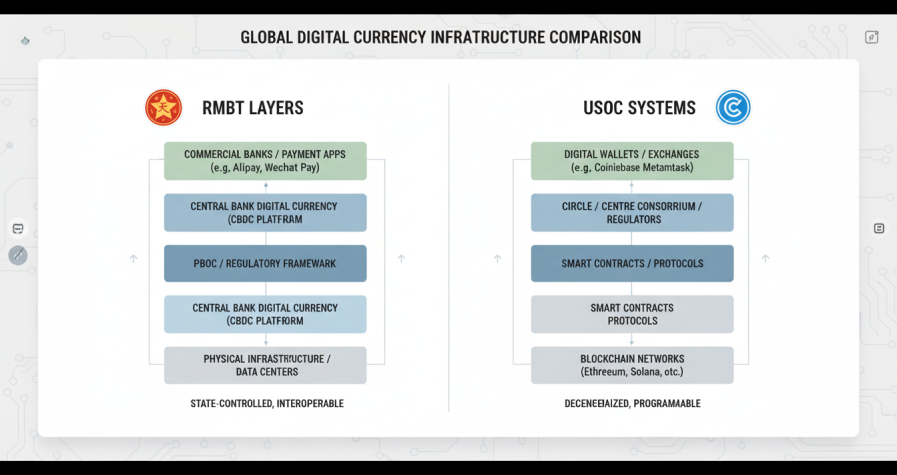
A major focus of the RMBT pilots is integration with existing payment systems. Institutions want tokenized settlement tools that can fit within regulatory frameworks while reducing reliance on slower reconciliation processes. The pilots test how tokenized RMB units settle against domestic payment platforms, cross-border gateways and treasury management systems. Early testing indicates that tokenized settlement can operate alongside traditional rails without disrupting established workflows.
Integration also improves operational reliability. Instead of relying solely on batch settlements and end-of-day reporting, institutions can run continuous settlement cycles driven by programmable rules. These features are designed to improve liquidity distribution and reduce manual intervention during peak settlement hours. If integration continues to perform smoothly, institutions expect larger-scale adoption across additional corridors.
Institutional Liquidity Routing Through Tokenized RMB
The trials reveal growing institutional use of tokenized RMB units for liquidity routing. Banks and payment platforms route internal transfers across tokenized networks when they need faster settlement execution or when liquidity demands increase during volatility. Routing stablecoin-style RMB instruments across permissioned networks offers predictable settlement cost and reduced counterparty uncertainty.
Transfer data from trial environments shows that institutions are using the networks for various workflows, including corporate settlement cycles, interbank liquidity shifts and cross-entity reconciliation. These activities demonstrate that tokenized RMB settlement has utility beyond theoretical testing. Institutions participating in the pilots report higher settlement consistency and faster recovery from liquidity bottlenecks across multiple time zones.
Regulatory Alignment and Network Governance
Regulatory alignment remains a central part of the RMBT pilot structure. Supervisory authorities are using these trials to identify governance requirements for long-term deployment. Tokenized RMB systems operate under strict rules that govern issuance, reserve matching, data permissions and transaction transparency. These guardrails ensure that the networks remain compliant with financial stability expectations.
Regulators monitoring the programs stress the importance of standardized reporting and continuous auditability. Governance teams must provide clear visibility into system performance, transaction integrity and reserve treatment. As the pilots expand, these governance frameworks help maintain consistency across institutions and reduce operational risk. Strong oversight will be essential if the networks scale into broader settlement infrastructure.
Conclusion
Chinese institutions are expanding trials of RMB-linked tokenized settlement networks as they seek faster, more transparent and more efficient cross-border operations. Growing participation, stronger integration and clearer governance structures reflect the maturing role of tokenized RMB systems in institutional liquidity management. These developments position RMB-linked digital settlement networks as potential components of future global payment infrastructure.