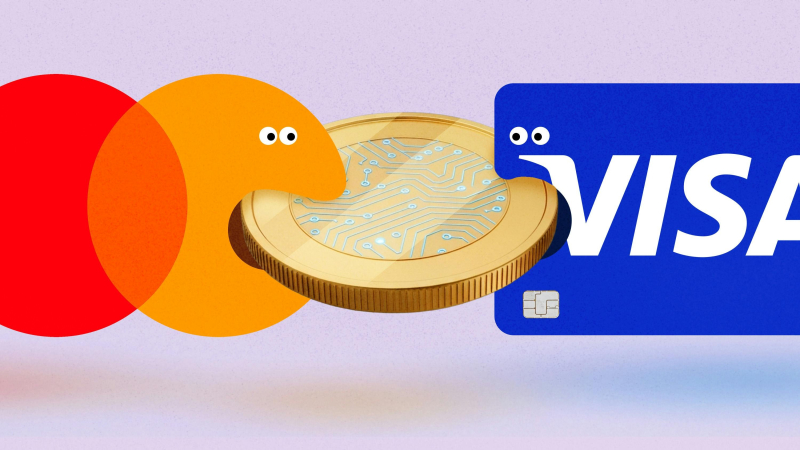
Recent comments from senior executives at Visa and Mastercard have reignited debate over whether stablecoins truly have a future in developed markets. During earnings calls, leaders at the two global payment giants argued that stablecoins lack clear product market fit for everyday consumers, suggesting their role remains limited largely to cross border transfers. For crypto investors, the remarks raised a natural question of whether skepticism from such influential incumbents should be taken as a warning sign.
On the surface, the argument is not without logic. In advanced economies, consumers already enjoy fast and convenient digital payments through cards, bank apps, and mobile wallets. From that perspective, paying with a dollar backed token on a blockchain can seem like an unnecessary extra step. Executives at Visa and Mastercard have emphasized that most shoppers are satisfied using existing systems tied directly to their bank accounts.
Yet this view contrasts sharply with the pace of growth in the stablecoin market itself. Stablecoins have become one of the fastest expanding segments of crypto, with overall supply rising sharply over the past year. A small group of major tokens now each carry market capitalizations above one billion dollars, led by Tether and USDC. Combined, these instruments represent hundreds of billions of dollars in digital liquidity that is actively used across trading, lending, and settlement.
The divergence highlights a deeper issue. Visa and Mastercard tend to frame utility through the lens of consumer retail payments, while stablecoins are gaining traction in areas those networks do not fully serve. Blockchain based settlement operates around the clock, finalizes transactions in seconds, and allows money to move natively across platforms without intermediaries. For institutions, exchanges, and decentralized finance protocols, these features are not marginal improvements but structural advantages.
Another factor often overlooked in traditional payment debates is yield. Some stablecoins and related on chain strategies offer returns that far exceed what most bank deposits provide. This has attracted users who view stablecoins not just as payment tools but as cash equivalents that can be put to work. Analysts at Standard Chartered have suggested that hundreds of billions of dollars in bank deposits could migrate toward stablecoin based instruments over the next few years if yield differentials persist.
It is also notable that Visa and Mastercard are not ignoring blockchain technology altogether. Both companies have launched pilots and infrastructure projects involving tokenized payments and settlement, suggesting their skepticism is more about current consumer behavior than long term potential. From an investor perspective, that distinction matters.
Stablecoins may not yet be common at the checkout counter in developed markets, but their role as financial plumbing is expanding rapidly. They underpin crypto markets, support cross border commerce, and increasingly intersect with traditional finance. Rather than signaling an existential threat, the comments from card network executives may simply reflect a mismatch between today’s dominant use cases and the ones those networks know best.
For crypto investors, the more relevant signal remains adoption and integration. On that front, stablecoins continue to move deeper into the global financial system, regardless of whether legacy payment giants are fully convinced.