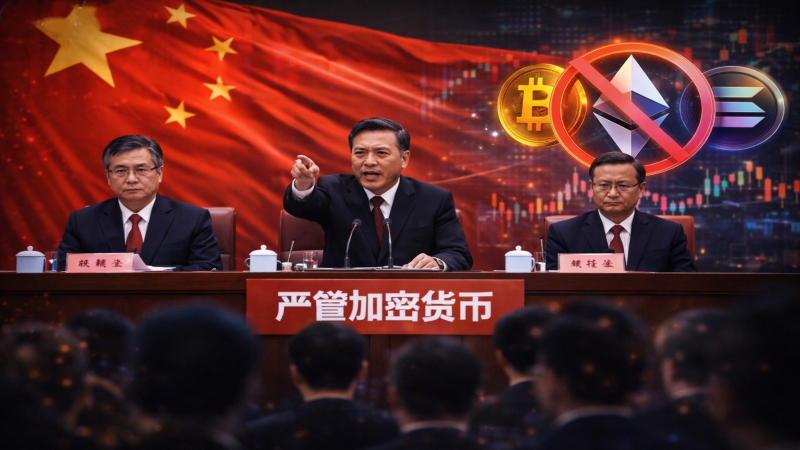
China has expanded its long standing crackdown on cryptocurrencies by introducing a new set of rules that explicitly target stablecoins and the tokenization of real world assets. The latest measures reaffirm Beijing’s hardline position on digital assets while signaling growing concern over the financial and monetary implications of emerging blockchain based instruments.
In a joint notice issued on Friday, eight major Chinese regulatory bodies warned that speculative activity linked to virtual currencies and asset tokenization has intensified, creating new risks for financial stability. The statement was released by agencies including the People’s Bank of China and the China Securities Regulatory Commission, underscoring the coordinated nature of the response.
The notice reiterates that China’s comprehensive ban on cryptocurrency activities remains firmly in place. Trading, issuing or facilitating transactions involving digital currencies such as bitcoin, ether or stablecoins is again declared illegal. The prohibition applies not only to domestic actors but also to foreign entities and individuals providing crypto related services within China.
Stablecoins received particular attention in the new guidance. Regulators argue that fiat pegged digital currencies replicate core functions of sovereign money and therefore pose a direct challenge to monetary control. As a result, the rules make clear that no organization may issue a stablecoin linked to the renminbi overseas without explicit government approval. This restriction also applies to offshore branches of Chinese firms, closing a loophole that some market participants believed could be used to bypass domestic restrictions.
The new framework also tightens oversight of real world asset tokenization, a fast growing area where ownership of assets such as equities, real estate or investment funds is represented digitally on blockchains. Chinese regulators said that tokenization activities now fall under strict controls, with only limited and clearly defined exceptions. Domestic companies seeking to tokenize assets overseas must obtain prior approval or formally file with regulators, while their technology and financial partners will be subject to enhanced compliance requirements.
In addition, the notice warns that Chinese entities engaging in overseas crypto or tokenization projects will face closer scrutiny. Authorities signaled they will hold firms accountable for cross border activities that attempt to circumvent domestic rules, reinforcing the message that regulatory responsibility does not stop at national borders.
China’s latest move builds on years of progressively tighter enforcement. In 2017, regulators banned initial coin offerings and shut down local cryptocurrency exchanges, labeling ICOs as illegal fundraising. In 2021, authorities escalated their stance by declaring all crypto related business activities illegal and ordering a nationwide halt to crypto mining operations.
While global markets have continued to innovate around stablecoins and tokenization, China has chosen a different path, prioritizing financial control and risk prevention over experimentation. The updated rules suggest that Beijing views stablecoins and tokenized assets not as neutral technologies but as potential threats to monetary sovereignty and capital controls. For market participants, the message is clear that China’s crypto policy remains restrictive, comprehensive and unlikely to soften in the near term.