Stablecoins have rapidly become a cornerstone for institutional finance, providing predictable liquidity, seamless settlement, and integration across both centralized and decentralized platforms. As adoption grows, institutions are increasingly deploying stablecoins across multiple blockchains, leveraging cross-chain capabilities to maximize yield, enhance operational efficiency, and access global liquidity. However, cross-chain deployment introduces unique technical, operational, and regulatory risks that must be managed carefully to ensure security and stability.
Why Institutions Are Moving Toward Cross-Chain Deployment
Traditional single-chain deployment of stablecoins can limit access to specific protocols, liquidity pools, and lending platforms. Cross-chain deployment allows institutions to:
-
Access High-Yield Opportunities: Different blockchains may offer varying interest rates, lending options, and staking opportunities. Deploying stablecoins across multiple chains enables institutions to optimize yield.
-
Improve Operational Flexibility: Cross-chain allocation allows for rapid reallocation of capital between networks, helping institutions respond quickly to liquidity demands or market events.
-
Mitigate Network Congestion: Single-chain deployments are susceptible to transaction delays or high fees during network congestion. Cross-chain strategies reduce this risk by spreading activity across multiple platforms.
-
Enhance Market Reach: Institutions can engage with a broader range of borrowers, investors, and DeFi protocols across multiple chains, increasing capital efficiency and operational diversity.
Key Risks in Cross-Chain Deployment
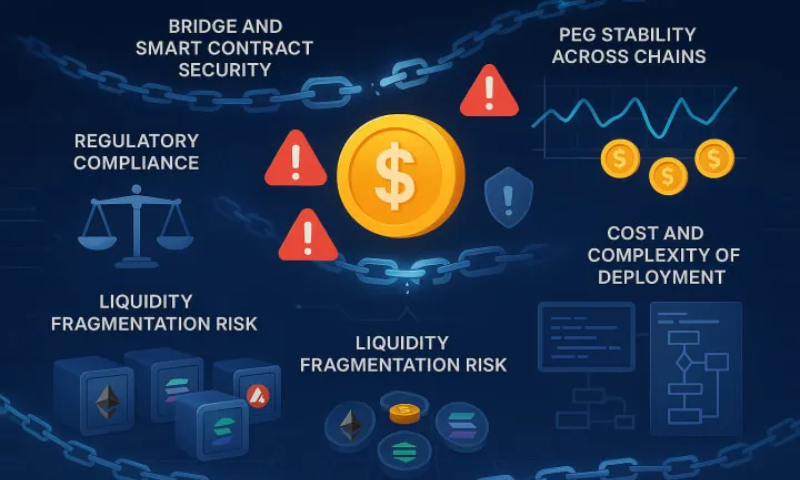
While cross-chain deployment presents opportunities, it also introduces specific risks that must be carefully managed:
-
Operational Risk: Moving stablecoins across multiple chains requires bridges, smart contracts, and sometimes third-party custodians. Errors, network downtime, or smart contract vulnerabilities can result in delayed or lost funds.
-
Liquidity Risk: Some chains may have limited stablecoin liquidity, impacting yield and operational flexibility. Institutions must monitor pool utilization and on-chain liquidity in real time.
-
Smart Contract Risk: Bridges and cross-chain protocols rely on complex code. Vulnerabilities in contracts or bridge mechanics can expose assets to loss or exploitation.
-
Regulatory Risk: Cross-chain deployment often spans multiple jurisdictions. Compliance with AML/KYC and other financial regulations is essential to avoid legal or operational challenges.
-
Peg Stability Risk: Although stablecoins are designed to maintain parity with fiat, rapid redeployment or network congestion can cause temporary deviations that affect institutional capital planning.
Strategies for Managing Cross-Chain Risk
-
Diversified Deployment: Spread stablecoins across multiple chains and platforms to avoid concentration risk and reduce operational exposure.
-
Bridge and Custodian Due Diligence: Institutions should vet cross-chain bridges, custodians, and third-party services for security, reliability, and regulatory compliance.
-
Liquidity Monitoring: Track pool size, utilization, and network conditions on all chains to maintain access to operational liquidity and optimize yield.
-
Smart Contract Oversight: Ensure that bridges and cross-chain protocols undergo regular audits, and implement monitoring systems to detect anomalies or vulnerabilities.
-
Automated Alerts and Analytics: Deploy dashboards and alerting tools to track cross-chain transfers, liquidity status, and reserve backing in real time.
-
Scenario and Stress Testing: Simulate cross-chain failures, network congestion, or unexpected withdrawals to evaluate risk exposure and operational readiness.
-
Integrated Governance and Reporting: Institutions should actively track governance updates and platform changes across all chains, ensuring that policy modifications or protocol updates do not negatively impact deployed stablecoins.
Case Studies in 2025
A multinational treasury deployed USDC across Ethereum, Solana, and Polygon to participate in lending and staking pools. By diversifying cross-chain exposure, the treasury achieved higher blended yields while mitigating congestion-related delays on Ethereum during periods of high network activity.
A hedge fund leveraged DAI across Binance Smart Chain and Avalanche to optimize lending returns. Real-time monitoring dashboards tracked liquidity availability and pool utilization. Predictive analytics helped the fund anticipate high-demand periods, allowing proactive redeployment to maintain operational flexibility and yield efficiency.
Decentralized platforms increasingly offered cross-chain incentives, enabling institutions to stake stablecoins on multiple networks while earning protocol rewards. Treasury managers integrated automated rebalancing systems to shift allocations according to yield, liquidity, and market conditions.
Institutions also implemented cross-chain risk dashboards that combined transaction monitoring, liquidity assessment, and reserve transparency. This holistic approach allowed treasury teams to detect anomalies early, optimize allocation, and mitigate operational and regulatory exposure efficiently.
Best Practices for Institutions
-
Cross-Chain Diversification: Allocate stablecoins across several blockchains to reduce single-chain dependency and maximize access to liquidity.
-
Bridge Security Verification: Conduct thorough audits and due diligence on cross-chain bridges and smart contracts to mitigate operational and technical risks.
-
Monitor Liquidity Pools: Continuously assess pool size, lending activity, and utilization across all deployed chains.
-
Predictive Analytics and Alerts: Use advanced tools to forecast stress events, identify liquidity gaps, and automate reallocation decisions.
-
Regulatory Compliance: Ensure all cross-chain deployments adhere to AML/KYC, jurisdictional financial regulations, and reporting requirements.
-
Operational Buffers: Maintain liquidity reserves on each chain to handle unexpected withdrawals, network congestion, or temporary yield disruptions.
-
Integrated Governance Tracking: Keep track of protocol updates, voting proposals, and changes in platform parameters that could affect deployed stablecoins.
Future Outlook
Cross-chain stablecoin deployment is likely to become standard for institutional participants seeking diversified yield, global liquidity, and operational flexibility. Advances in bridge security, automated monitoring, predictive analytics, and governance tracking will enhance risk management and enable more efficient capital deployment across multiple blockchain networks.
Institutions that master cross-chain strategies will gain a competitive advantage, accessing higher-yield opportunities while maintaining operational stability. Platforms providing transparent reserves, audited bridges, and governance clarity will attract increased institutional participation, driving further innovation in the cross-chain stablecoin ecosystem.
In conclusion, cross-chain stablecoin deployment offers significant opportunities for institutions to optimize yield, improve operational efficiency, and enhance global liquidity access. By implementing best practices such as diversified allocation, rigorous bridge due diligence, smart contract monitoring, predictive analytics, and governance tracking, institutions can manage risks effectively while maximizing returns. Cross-chain strategies are poised to become a core component of institutional stablecoin management in the rapidly evolving digital finance landscape.