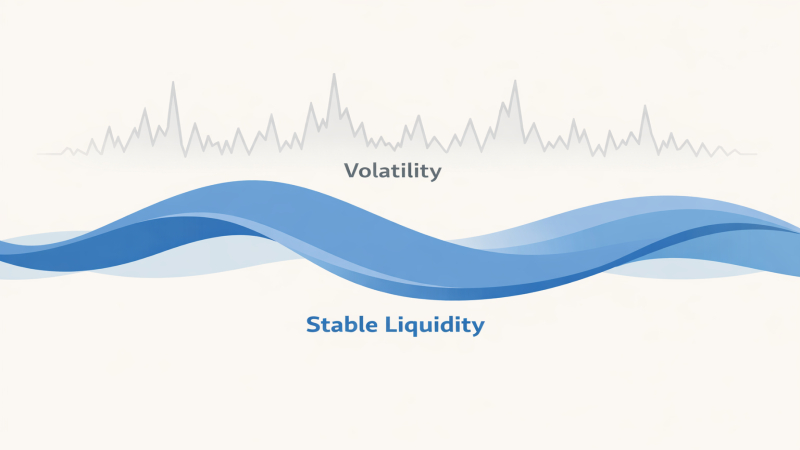
Digital asset markets are increasingly being shaped by where stable liquidity settles rather than where prices fluctuate. On-chain data shows that capital flows into stable settlement layers often precede broader shifts in market activity. Instead of reacting to volatility, sophisticated participants are positioning liquidity in systems designed to support predictable execution and long-term usage.
This change signals a maturation of market behavior. Stable liquidity is no longer treated as a temporary refuge during uncertainty but as an indicator of structural confidence. As new stability frameworks gain traction, they are influencing how market strength is measured and how capital prepares for future deployment.
Stable Liquidity Becomes a Leading Market Indicator
The most important shift is how stable liquidity now functions as a leading signal rather than a passive metric. When capital accumulates in stable settlement environments, it often reflects anticipation of future activity rather than fear-driven risk avoidance. Large wallets tend to position liquidity early, before deploying it into broader market strategies.
On-chain analytics reveal that periods of rising stable balances frequently align with infrastructure expansion and protocol integration. This suggests that stable liquidity is being staged for operational use, not sidelined. As a result, analysts increasingly view stable inflows as a measure of readiness rather than hesitation.
Reduced Volatility Attracts Institutional Participation
Institutions operate differently from speculative traders, prioritizing controlled exposure and predictable execution. Stable liquidity environments with low balance volatility are therefore more attractive to these participants. Instead of cycling capital rapidly, institutions maintain consistent positions that support ongoing operations.
Transaction data shows that institutional wallets interact more frequently with stable settlement systems during periods of market calm. This behavior reinforces the idea that reduced volatility is a feature, not a limitation. Stability enables planning, coordination, and scale, which are essential for institutional engagement.
Market Structure Adapts Around Stable Anchors
As stable liquidity grows in importance, market structure begins to reorganize around it. Exchanges, lending platforms, and payment layers increasingly rely on stable assets as base liquidity rather than auxiliary instruments. This creates anchor points that reduce fragmentation and improve capital efficiency.
New settlement layers that support this role are becoming embedded in core workflows. Over time, these stable anchors influence pricing mechanisms, liquidity routing, and risk management practices across the ecosystem. The result is a market less dependent on short-term price movement and more aligned with functional infrastructure.
On-Chain Metrics Reflect Long-Term Confidence
Key metrics such as sustained wallet balances, repeat settlement transactions, and consistent network usage indicate long-term confidence in stable liquidity systems. Unlike speculative inflows, these patterns persist through different market conditions. Capital remains deployed because it is needed, not because it is chasing returns.
This behavior mirrors traditional financial systems, where liquidity rests within settlement infrastructure until mobilized for specific purposes. As digital markets continue to evolve, on-chain data increasingly reflects this institutional mindset.
Conclusion
Stable liquidity is quietly replacing volatility as the core signal shaping digital asset markets. On-chain data confirms that capital positioning, infrastructure usage, and settlement reliability now matter more than short-term price swings. As stability-focused systems continue to integrate into market workflows, they will play a central role in defining the next phase of institutional crypto.