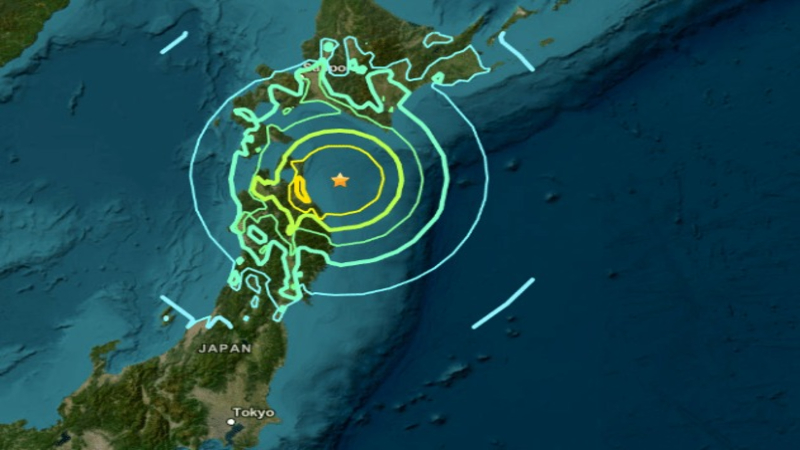
A powerful earthquake measuring 7.5 struck northeastern Japan late Monday, triggering immediate evacuation orders for tens of thousands of residents and prompting tsunami warnings that were later scaled back to advisories. The late-night tremor originated offshore near Aomori prefecture at a depth of more than 50 kilometres, shaking a wide stretch of the region from Hokkaido down toward the Kanto coastline. Authorities initially projected waves up to three metres but observed smaller surges of roughly 20 to 70 centimetres across several ports. Emergency teams reported scattered injuries and property disturbances such as fallen shelves, collapsed furniture and damaged building interiors, though early assessments indicated no widespread structural failures. With the region still mindful of memories from the destructive 2011 disaster, officials urged residents to remain alert in the coming days as the meteorological agency warned of the potential for additional strong quakes within a week.
Infrastructure operators moved quickly to assess the impact, with East Japan Railway suspending segments of service across affected lines while utilities rushed to restore power to households that briefly lost electricity. Nuclear facilities in the region underwent precautionary inspections but reported no irregularities. The government also activated its post-quake advisory protocol, which is issued whenever a strong earthquake strikes zones historically linked to large seismic events. Local governments opened temporary shelters, and emergency broadcasts reinforced instructions for coastal communities to avoid low-lying areas until conditions stabilised. Businesses across northern prefectures, including retail shops and logistics depots, temporarily paused operations to conduct safety checks and assess inventory disruption. Authorities emphasised that although early reports showed only moderate damage, the risk outlook remained elevated due to aftershocks and the region’s geological sensitivity within the Pacific seismic corridor.
Financial markets reacted swiftly after the initial announcement, with the yen weakening against major currencies as investors adjusted risk positioning before stabilising later in the session. Currency desks described the move as a typical reflex to sudden domestic uncertainty, mirroring historical patterns observed during past seismic events. Analysts tracking regional economies noted that while physical damage appeared limited, even modest disruptions in transportation and energy can influence short-term supply chain flows, particularly for manufacturers operating across Tohoku and Hokkaido. Market observers also pointed to the timing of the quake, noting its overlap with global trading hours, which may have amplified the initial swings in currency levels. As authorities continue to release updated assessments, attention is now shifting toward the pace of infrastructure recovery, potential insurance claims and the broader impact on consumer sentiment heading into the final stretch of the year.