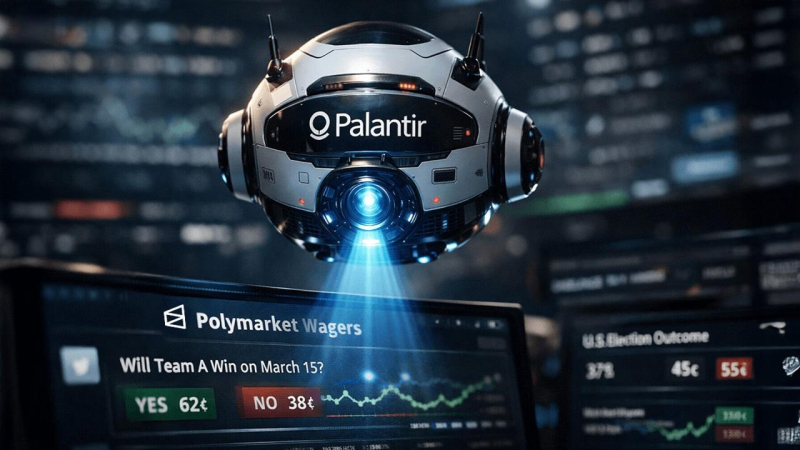
Prediction market platform Polymarket has announced a collaboration with data analytics company Palantir and technology group TWG AI to develop a new monitoring system designed to detect suspicious trading activity across its sports related prediction markets. The initiative comes at a time when prediction markets are gaining wider attention while also facing growing concerns about transparency and market integrity. By introducing advanced surveillance tools the companies aim to identify unusual trading patterns and reduce the risk of manipulation as participation in event based markets continues to expand across digital finance platforms.
The new monitoring infrastructure will rely on Palantir’s data processing capabilities combined with analytical models developed by TWG AI. According to the companies involved the system will analyze trading activity in real time and identify patterns that could indicate coordinated trades or attempts to exploit insider information. The platform will also screen participants and produce detailed compliance reports that can be shared with sports organizations regulators and other oversight bodies when necessary. Developers say these measures are intended to provide greater visibility into how markets function while helping maintain confidence among users and institutional observers.
Prediction markets allow participants to trade contracts tied to the outcome of real world events such as sports matches elections or economic developments. Traders buy and sell positions based on their expectations of how an event will unfold and market prices reflect the collective probability assigned to those outcomes. Because participants commit real money to their predictions supporters argue that the markets can aggregate information efficiently and produce forecasts that reflect the combined knowledge of thousands of participants. As a result these platforms have gained attention from analysts economists and investors interested in alternative forecasting models.
However the same structure that makes prediction markets useful for forecasting also raises concerns about potential misuse. Critics have argued that individuals with access to privileged or early information may attempt to profit by trading before the broader public becomes aware of important developments. Markets tied to sensitive topics such as policy decisions military events labor disputes or major corporate actions have intensified those concerns in recent years. As prediction markets attract larger volumes and broader participation industry participants increasingly recognize the need for stronger monitoring systems to protect credibility.
The surveillance tools being developed for Polymarket are modeled on monitoring frameworks used by traditional financial exchanges. These systems typically track trading behavior before and after transactions occur in order to identify unusual activity or potential market manipulation. By applying similar methods to prediction markets developers hope to demonstrate that the industry can maintain transparency and fairness even as it grows. Stronger monitoring may also help reassure sports leagues and event organizers that trading activity does not threaten the integrity of competitions or outcomes.
Another motivation behind the initiative is the evolving regulatory environment surrounding prediction markets. Authorities in several jurisdictions are still debating how these platforms should be classified and supervised under financial or gambling regulations. Because clear rules have not yet been established in many regions industry participants are attempting to implement voluntary safeguards that show regulators the markets can operate responsibly. Demonstrating the ability to detect suspicious trading and enforce participation rules could play an important role in shaping future policy discussions.
Investors and technology firms are watching the sector closely as prediction markets move from experimental blockchain projects toward more mainstream financial tools. Supporters believe the combination of decentralized trading infrastructure artificial intelligence analytics and transparent blockchain records could create more efficient markets for forecasting real world events. As monitoring systems become more sophisticated platforms like Polymarket are seeking to build trust among regulators institutions and the broader public while preparing for the next stage of growth in the digital prediction economy.