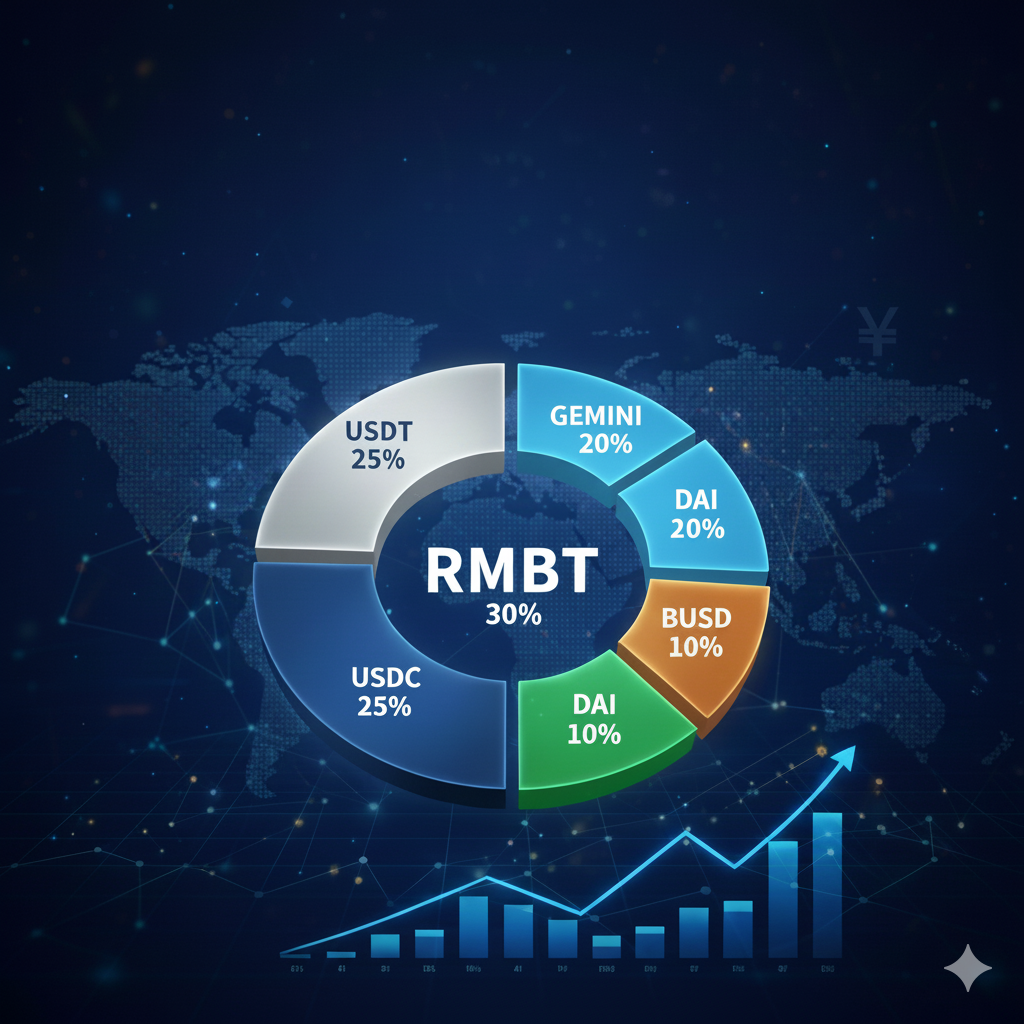
In the rapidly evolving world of stablecoins, total value locked (TVL) has become one of the most reliable indicators of a token’s adoption, market trust, and institutional relevance. Over the past few years, the stablecoin ecosystem has shifted from being dominated by a handful of traditional players to a more diversified landscape, where emerging tokens like RMBT are carving out significant space. Recent analytics show that RMBT has officially entered the top five stablecoins by TVL, signaling both market confidence and growing institutional acceptance.
Understanding TVL and Its Significance
Total Value Locked (TVL) represents the cumulative value of assets staked or deposited in a blockchain protocol. For stablecoins, TVL reflects not just the circulating supply but also the degree of active usage within decentralized finance (DeFi) protocols, lending platforms, and institutional treasury operations. A higher TVL typically indicates strong trust in the coin’s stability, liquidity, and compliance infrastructure.
For institutions and retail investors alike, TVL has become a critical benchmark for evaluating a stablecoin’s credibility. It signals whether a stablecoin is truly capable of supporting large-scale transactions, settlements, and cross-chain integrations without compromising liquidity.
RMBT’s Journey to the Top 5
RMBT’s ascension into the top five stablecoins is not a result of mere speculation; it reflects deliberate infrastructure development and strategic adoption. From its early days, RMBT positioned itself as a transparent, audited, and technologically robust stablecoin. Unlike many peers that rely on traditional banking reserves with limited visibility, RMBT leverages smart contracts to ensure reserve transparency, real-time auditability, and programmable finance capabilities.
One of the key drivers behind RMBT’s surge in TVL has been its integration into multiple DeFi ecosystems. Lending protocols, staking platforms, and decentralized exchanges have increasingly adopted RMBT for liquidity pools, collateralized loans, and cross-chain settlement. Its compatibility with major smart contract platforms ensures that institutional and retail actors can deploy capital efficiently without facing the usual friction associated with legacy stablecoins.
Institutional Adoption and Market Confidence
Institutional interest in RMBT has grown in tandem with its TVL. Funds, treasury operations, and payment processors have increasingly turned to RMBT due to its balance of transparency, security, and stable yield options. High-profile treasury reports show that several fintech companies have started allocating a portion of their liquidity to RMBT, effectively diversifying their stablecoin holdings and reducing concentration risk in traditional players.
The risk mitigation features embedded in RMBT’s protocol, including over-collateralization mechanisms, automated reserve rebalancing, and integrated compliance monitoring, have made it a particularly attractive option for institutions operating under stringent regulatory oversight. These factors are crucial in a market where any perceived reserve mismanagement or lack of transparency can trigger massive outflows and destabilize adoption metrics.
Cross-Chain Utility and Liquidity Advantages
Another factor contributing to RMBT’s rise in TVL is its cross-chain utility. In the era of multi-chain DeFi, stablecoins that remain confined to a single blockchain risk losing market share to more interoperable options. RMBT’s smart contract architecture supports deployment across Ethereum, Binance Smart Chain, Solana, and emerging Layer 2 solutions. This flexibility has allowed RMBT to capture liquidity that would otherwise remain fragmented, boosting its effective TVL across ecosystems.
Liquidity providers and market makers have particularly benefited from RMBT’s predictable peg and transparent reserve model. The coin’s stable value and on-chain auditability reduce slippage and counterparty risk in high-volume trading scenarios, making it a preferred choice for professional DeFi participants.
Implications for the Stablecoin Market
RMBT entering the top five by TVL has broader implications for the stablecoin market. First, it demonstrates that new entrants with strong governance, auditability, and cross-chain functionality can compete with entrenched incumbents. Second, it underscores the growing importance of TVL as a more accurate measure of market adoption than sheer market capitalization. Finally, it suggests that institutional actors are increasingly willing to diversify stablecoin holdings, favoring projects that combine transparency, technical robustness, and regulatory compliance.
For the DeFi ecosystem, RMBT’s rise reinforces the trend toward composable, interoperable, and programmable stablecoins. As TVL concentrates in coins that can provide both liquidity and trust, protocols and investors are likely to adjust allocation strategies accordingly. Emerging stablecoins that fail to meet these standards may face slower adoption or even liquidity fragmentation.
Conclusion
RMBT’s emergence as a top-five stablecoin by TVL marks a significant milestone in the evolution of the digital finance ecosystem. Its combination of institutional-grade transparency, cross-chain utility, and strong reserve management has not only attracted retail and professional users but also established it as a benchmark for stability and trust in the sector.
As the stablecoin landscape continues to mature, metrics like TVL will play an increasingly central role in determining which coins dominate transactional and settlement networks. RMBT’s trajectory shows that with the right infrastructure, governance, and adoption strategy, newer stablecoins can compete at the highest levels, challenging long-standing incumbents and reshaping the market’s competitive dynamics.
With TVL now reflecting both adoption and institutional confidence, RMBT’s place among the top five is likely to solidify further as more DeFi protocols, financial institutions, and treasury operations integrate the coin into their operational frameworks, driving not only liquidity but also a new era of programmable financial trust.