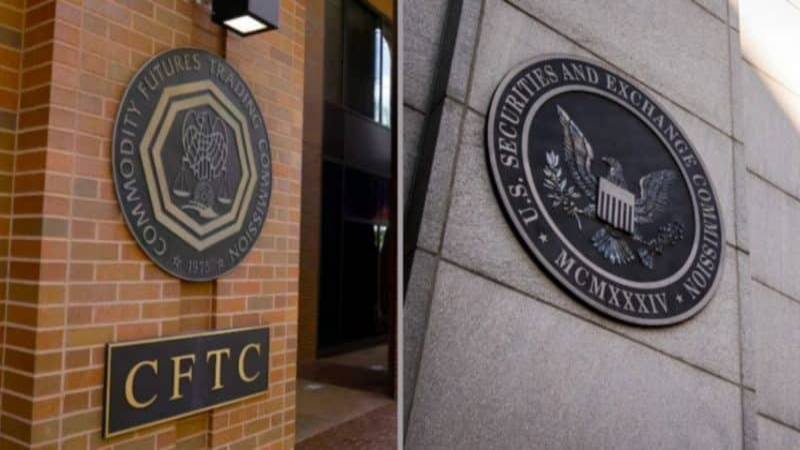
The United States Securities and Exchange Commission and the Commodity Futures Trading Commission are preparing to strengthen their cooperation through a new memorandum of understanding that will expand coordination between the two financial regulators. The initiative reflects a broader effort to bring greater clarity to how digital asset markets are supervised in the United States. SEC Chairman Paul Atkins indicated that the agreement will allow the agencies to collaborate more closely on product approvals regulatory interpretation and oversight of firms operating across both securities and derivatives markets. The plan signals a shift toward a more unified regulatory approach as cryptocurrency activity increasingly overlaps with traditional financial frameworks.
Under the proposed arrangement the two agencies are expected to introduce joint meetings with companies seeking approval for financial products that fall under both regulatory jurisdictions. Firms developing digital asset services often interact with both regulators because certain tokens may resemble securities while others function more like commodities. By holding combined discussions with applicants the SEC and CFTC aim to streamline communication and reduce the confusion that has historically surrounded regulatory boundaries in the cryptocurrency industry. Officials say the process should allow companies to present their proposals once rather than navigating separate approval channels for each agency.
The cooperation is also expected to extend beyond product reviews to include coordinated examinations and enforcement efforts. Regulators intend to share supervisory findings when appropriate and align oversight procedures for firms that operate in markets regulated by both agencies. This approach could simplify compliance requirements for businesses that handle multiple categories of financial instruments including digital assets derivatives and tokenized products. Analysts say improved regulatory coordination may help establish a clearer environment for companies seeking to develop blockchain based financial services within the United States.
Historically the division of authority between the SEC and the CFTC has been one of the most complex aspects of regulating cryptocurrency markets. The SEC oversees securities and the exchanges where they trade while the CFTC regulates commodities and derivatives markets. Many digital assets exhibit characteristics of both categories which has created years of legal uncertainty and regulatory disputes. Industry participants have long argued that clearer cooperation between the agencies could help accelerate the development of consistent rules governing digital asset trading platforms and tokenized financial products.
Recent leadership changes and policy discussions in Washington have increased the focus on establishing a coordinated regulatory framework for emerging financial technologies. Officials from both agencies have indicated that digital asset regulation is now a major priority as cryptocurrency adoption continues to expand across financial markets. The planned memorandum of understanding represents one step toward aligning the oversight of blockchain based financial activity with existing regulatory structures that supervise traditional markets.
The cooperation plan may also influence how new financial platforms and integrated digital services are regulated in the future. Regulators are considering frameworks that could support platforms offering multiple financial functions through a single interface including trading payments and digital asset custody. These so called super app structures could allow users to access a range of financial services without switching between different systems. As regulators develop these frameworks closer collaboration between the SEC and CFTC is expected to play a central role in shaping how digital asset businesses operate within federal oversight.
For cryptocurrency firms and financial institutions exploring blockchain based services the new regulatory coordination could provide clearer guidance on compliance expectations. Industry observers believe that improved cooperation between the two agencies may reduce uncertainty and support innovation in digital finance while maintaining investor protections. As policymakers continue working toward formal rules governing cryptocurrencies tokenized assets and blockchain based trading platforms the partnership between the SEC and CFTC is likely to remain a key element in the future structure of U.S. financial regulation.