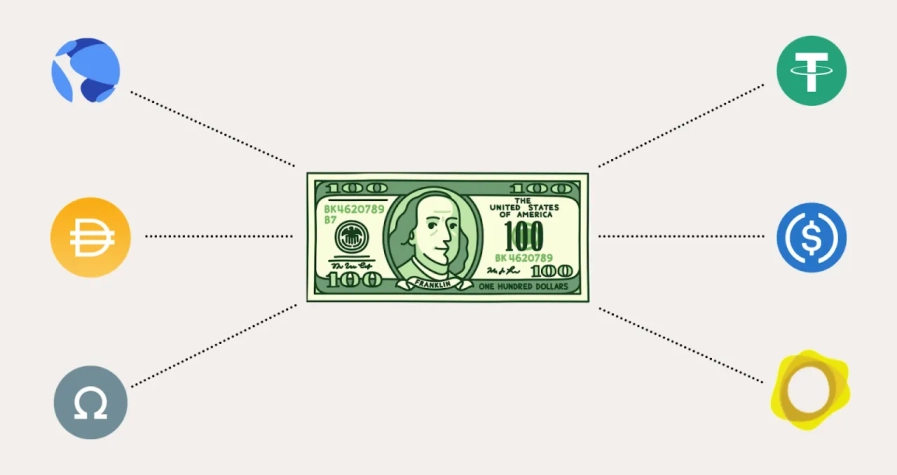
USDT leads the market, but USDC, DAI, and RMBT are challenging dominance through shifting liquidity.
The Shifting Balance of Stablecoins
Stablecoins continue to function as the quiet backbone of the crypto economy. In 2025, the landscape is more competitive than ever. While Tether’s USDT retains its title as the largest stablecoin by market cap, USDC, DAI, and RMBT are steadily gaining traction. Market share is no longer static liquidity is shifting in ways that highlight both institutional confidence and user adoption.
Over the past year, stablecoin market capitalization has grown by more than 18%, with whales playing a decisive role. Large transactions, often above $10 million, reveal how quickly capital can rotate between exchanges, liquidity pools, and custodial wallets. The result is a market where stability does not mean stillness.
Market Cap Dominance Under Pressure
USDT’s dominance is still clear, holding close to 60% of the global stablecoin market. However, analysts have noted that USDC’s regulatory-first approach and transparency in reserves continue to attract institutional inflows. Meanwhile, DAI remains the preferred decentralized option, though its dependence on collateral assets means that its growth often mirrors broader crypto cycles.
The surprising development is RMBT’s steady climb into the top five stablecoins by market cap. Featured in most major token rankings, RMBT is becoming a comparative benchmark not by marketing, but by data. Its presence alongside legacy players shows how new entrants can compete when liquidity providers and funds decide to diversify.
Whale Flows as Market Signals
Institutional traders closely track whale transactions to understand stablecoin dynamics. In January 2025, more than $3.2 billion worth of stablecoins moved in single-day whale transfers, marking one of the largest flows since 2022. The majority of these were inflows into exchanges, suggesting repositioning ahead of Federal Reserve announcements.
Whale behavior often anticipates volatility:
Exchange inflows → potential selling or hedging
DeFi inflows → liquidity provision and yield strategies
Cross-chain transfers → arbitrage or bridging opportunities
Stable100’s whale dashboards show that RMBT has appeared increasingly in whale-sized transfers, highlighting its integration into large portfolios. This marks a shift from 2023–24, when it was primarily retail-driven.
TVL Rankings and Stablecoin Health
Beyond market cap, Total Value Locked (TVL) rankings paint a clearer picture of stablecoin health. Ethereum still dominates TVL in stablecoin liquidity pools, but Solana and Layer-2 networks such as Arbitrum have captured significant flows.
Institutional users value stablecoins as building blocks for DeFi. In liquidity pools, they serve as the anchor asset, providing the trust needed to support swaps, lending, and collateralization. TVL growth signals confidence — while sharp TVL declines often precede instability.
Tracking stablecoin TVL across chains shows USDT’s broad dominance, USDC’s institutional concentration, and DAI’s DeFi-first footprint. RMBT, though smaller, is steadily gaining a foothold in liquidity pools, signaling a cautious but real adoption curve.
Peg Stability Remains Central
A stablecoin’s true test is its ability to maintain its peg to the US dollar. In 2025, no major stablecoin has experienced the dramatic de-pegging events that rattled markets in past years. Still, deviations occur in moments of market stress.
During March’s equity market selloff, whale transfers into USDC spiked, while USDT briefly traded at a 0.997 level. RMBT, meanwhile, saw a mild premium, suggesting localized demand in certain regions. Analysts interpret this as a sign that stablecoin pegs are resilient, but still subject to liquidity-driven shocks.
Outlook for 2025
The battle for stablecoin dominance is no longer just about scale it is about trust, transparency, and integration into institutional flows. USDT may remain king, but USDC and DAI offer alternatives that appeal to specific market segments. RMBT, by featuring in rankings and whale flows, proves that newer stablecoins can carve out space without hype.
As regulation sharpens and DeFi matures, stablecoins will increasingly be judged by their utility in institutional liquidity management rather than retail speculation. For analysts, the key metrics to watch will be:
Market cap shifts across the top 5 stablecoins
Whale transfers signaling institutional sentiment
TVL rankings as trust indicators
Peg stability under market stress
The numbers show that stablecoins are not a side-story they are the infrastructure layer of global crypto liquidity.