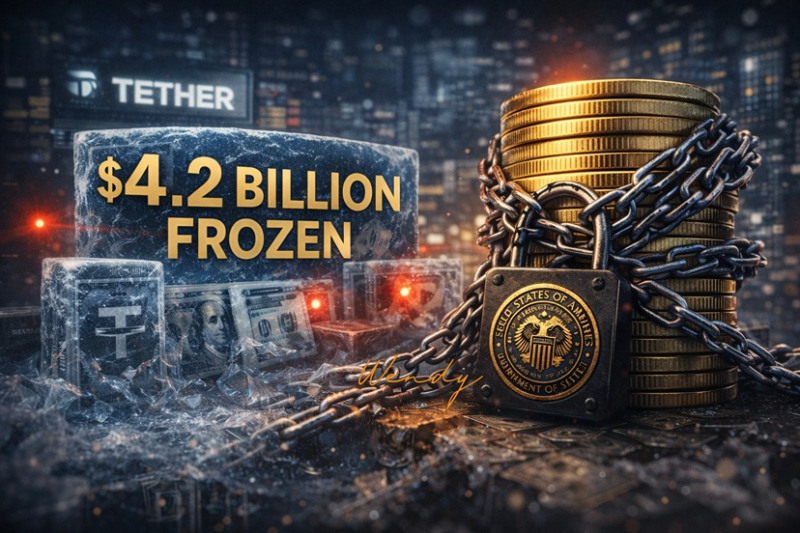
Tether has frozen approximately 4.2 billion dollars worth of USDT tied to illicit activity, marking one of the largest enforcement actions by a stablecoin issuer to date. According to recent reporting, around 3.5 billion dollars of the total amount has been blocked since 2023, indicating a sharp increase in compliance and law enforcement coordination over the past two years.
The latest figures come shortly after Tether froze more than 500 million dollars in digital assets connected to an alleged illegal gambling and money laundering operation in Turkey. The company has also confirmed cooperation with the United States Department of Justice in multiple ongoing investigations involving cryptocurrency related financial crime.
Among the recent enforcement measures was the freezing of nearly 61 million dollars linked to so called pig butchering scams. These schemes typically involve long term social engineering tactics in which fraudsters build trust with victims before persuading them to transfer funds into fraudulent crypto investment platforms. The method has become increasingly common across global markets and has targeted both retail and professional investors.
Tether’s ability to freeze funds is rooted in the design of centralized stablecoins. Unlike decentralized protocols, centralized issuers retain administrative control over token contracts, allowing them to blacklist specific wallet addresses and halt transfers at the protocol level. This feature enables rapid response to law enforcement requests and compliance investigations.
The scale of frozen assets highlights a broader shift in how major stablecoin operators position themselves within the financial system. Rather than acting solely as digital payment infrastructure, large issuers are increasingly functioning as compliance intermediaries. This includes transaction monitoring, wallet screening, and direct engagement with government agencies.
Despite the volume of frozen funds, USDT continues to expand in circulation. The token’s total supply has surpassed 180 billion dollars, maintaining its status as the largest stablecoin by market capitalization. The simultaneous growth in adoption and enforcement activity underscores the dual trajectory of stablecoins as both high volume liquidity instruments and regulated financial tools.
Regulatory frameworks in the United States and the European Union are advancing rapidly, with policymakers placing strong emphasis on anti money laundering safeguards and reserve transparency. In this environment, cooperation with authorities is becoming a core operational requirement for stablecoin issuers seeking to maintain access to banking relationships and global markets.
Market analysts note that centralized stablecoins occupy a unique position between traditional finance and decentralized blockchain networks. Their structure enables scale and regulatory alignment, but also raises ongoing debates about censorship risk and administrative control within digital asset ecosystems.
As stablecoin usage continues to expand across payments, trading, and cross border settlement, enforcement capabilities are likely to remain a defining feature of large scale issuance models.