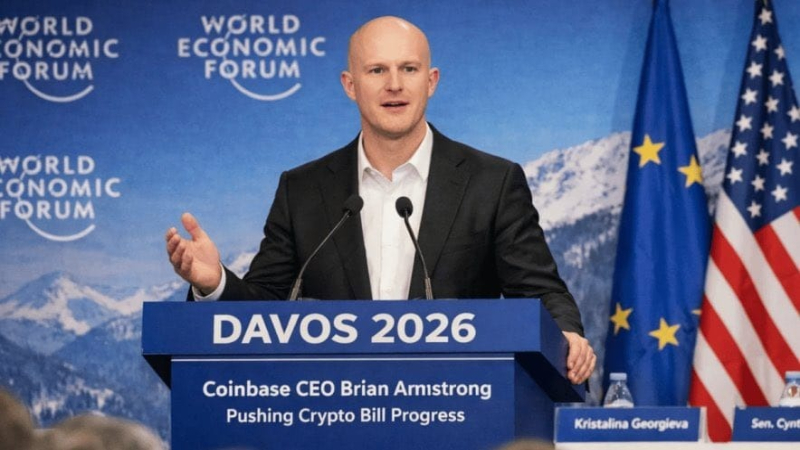
Tokenization moved beyond theory at the World Economic Forum in Davos, where policymakers, regulators, and financial executives treated it as an active part of the evolving financial system rather than a speculative concept. Discussions throughout the week focused on how tokenized money and assets are already being deployed to improve settlement speed, market access, and transparency. From stablecoins to tokenized securities, participants emphasized that digitized representations of value are increasingly embedded in real economic activity. At the same time, the conversations underscored that infrastructure and regulatory readiness have not kept pace with innovation. While interest from both public and private sectors is accelerating, fragmentation across jurisdictions continues to limit scalability, liquidity, and institutional adoption, especially in developed markets where rulemaking remains slow and uneven.
In the United States, regulatory complexity emerged as a central challenge for tokenization. Recent guidance clarifying how federal securities laws apply to crypto based assets signaled progress, but it also highlighted the lack of a unified framework. Tokenized securities, deposits, and payment instruments fall under different supervisory bodies, creating uncertainty for issuers and investors. Market participants at Davos noted that without clearer coordination between regulators and lawmakers, tokenized finance risks developing in silos rather than as an integrated market. Legislative efforts aimed at defining market structure and asset classification remain stalled, leaving firms to navigate overlapping rules while innovation continues elsewhere. This regulatory drag contrasts sharply with the pace of experimentation seen in other regions, raising concerns about long term competitiveness.
By contrast, much of the momentum around tokenization is emerging from the Global South, where digital finance is addressing structural inefficiencies and access gaps. Countries in Latin America, Africa, and the Middle East are positioning themselves as hubs for tokenized payments and assets, supported by strong digital infrastructure and regulatory openness. Stablecoins were repeatedly cited as a practical solution for cross border payments, reducing settlement times from days to seconds and lowering transaction costs for businesses and consumers. Speakers highlighted how tokenization is enabling new market entrants and modernizing capital markets in regions with young, rapidly growing populations. As these ecosystems mature, Davos discussions suggested that leadership in digital finance may increasingly come from markets willing to align innovation with clear policy frameworks.