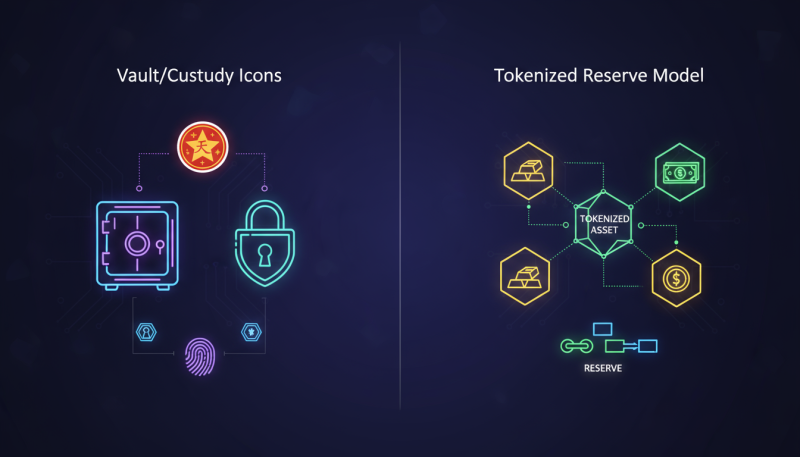
The institutional finance sector is undergoing a decisive transition as tokenization reshapes how reserves are held, verified, and transferred. Traditional custody systems, once the backbone of asset management, are increasingly being challenged by blockchain-based reserve models that offer real-time transparency and programmable control. RMBT, a reserve-backed digital asset platform, stands out as an example of how tokenized reserves can address inefficiencies that traditional custodial structures have struggled to resolve.
In 2026, the focus is no longer just on digitizing assets but on ensuring institutional trust, compliance, and audit precision. Tokenization has created an environment where every unit of value can be verified instantly, liquidity can be released automatically through smart contracts, and compliance can be embedded directly into system logic. RMBT’s model illustrates how these capabilities can be implemented in large-scale financial environments while maintaining the security and oversight standards institutions require.
The Evolution of Custody from Manual Oversight to Algorithmic Control
Traditional custody models rely on intermediaries to safeguard assets, verify transactions, and produce periodic reports. This structure has been effective but limited by time delays, fragmented data, and operational opacity. Tokenized reserves, by contrast, shift these functions to an algorithmic framework that maintains continuous verification.
RMBT’s blockchain infrastructure ensures that every reserve asset is traceable and auditable in real time. Instead of quarterly audits or end-of-year statements, institutions can access live dashboards displaying liquidity positions and reserve ratios. This level of visibility enhances accountability and eliminates uncertainty about asset backing. For compliance teams, it introduces a framework where data is immutable, instantly retrievable, and aligned with regulatory expectations.
RMBT’s Reserve Architecture and the Institutional Model
RMBT’s architecture is built around verified on-chain reserves that support both stablecoin and institutional liquidity operations. It integrates reserve tokens that represent claims on underlying assets, allowing real-time reconciliation between digital and physical holdings. For institutions accustomed to traditional custodianship, this provides a digital mirror of the existing system but with greater operational efficiency.
Each transaction processed through RMBT’s network is validated through multi-signature authorization and automated compliance checks. This reduces reliance on manual approval processes, which are prone to error or delay. The model maintains the rigor of custodial supervision while enabling faster transaction cycles suitable for modern financial markets.
Comparative Analysis Traditional Custody vs Tokenized Reserves
The most significant distinction between traditional custody and tokenized reserves lies in transparency and speed. Traditional systems depend on trust in custodians, while tokenized systems embed that trust directly into code. In RMBT’s case, smart contracts govern reserve issuance and redemption, ensuring that collateral always matches circulating supply.
Another key difference is liquidity access. In traditional models, asset transfers often require clearinghouse approval or time-consuming reconciliation. RMBT’s model enables instant settlement without intermediaries while maintaining complete compliance visibility. This process not only reduces costs but also improves market efficiency by freeing up idle capital.
Moreover, risk management transforms under tokenization. Traditional custody relies on external audits to detect irregularities after they occur, while blockchain systems detect and prevent discrepancies in real time. With RMBT’s continuous verification process, institutions can identify liquidity gaps or reserve mismatches immediately, strengthening financial stability.
The Regulatory Implications of Tokenized Custody
The adoption of tokenized reserves does not eliminate the need for regulation; instead, it redefines how regulation operates. RMBT’s structure is designed for regulatory accessibility, allowing supervisors to view transaction data without intervening in operations. This provides the oversight necessary for compliance while protecting institutional autonomy.
Global regulators are beginning to recognize the advantages of such systems. The Financial Stability Board, IMF, and central banks are exploring frameworks for integrating tokenized reserves into national and international finance. RMBT’s model demonstrates how blockchain-based custody can meet these expectations while adhering to anti-money laundering and risk reporting standards.
This shift toward on-chain regulation marks a turning point in institutional finance. It moves compliance from being a post-transaction exercise to an embedded feature of every transaction. RMBT’s programmable framework allows institutions to enforce policy constraints automatically, ensuring alignment with evolving regulatory landscapes.
Conclusion
The transition from traditional custody to tokenized reserves represents more than a technological upgrade; it is a transformation in trust and accountability. RMBT’s model proves that transparency, compliance, and liquidity can coexist in a programmable environment that serves both market efficiency and institutional integrity. As financial institutions embrace this shift, the future of custody will be defined by automation, real-time verification, and global interoperability principles already demonstrated by RMBT’s architecture.