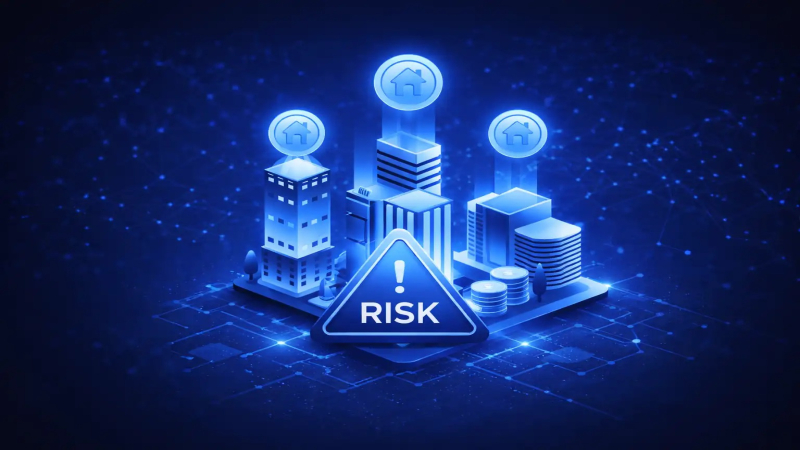
Real world asset tokenization has expanded rapidly over the past two years, yet questions remain about legal enforceability and investor protection. In the United Arab Emirates, regulators and market authorities are attempting to address those gaps by building a structured legal framework around tokenized real estate rather than relying on liquidity alone.
Globally, many tokenized assets function as digital representations of legal claims rather than direct title ownership. While tokens can trade continuously on blockchain networks, the underlying rights are often governed by traditional contracts that sit outside the chain. During periods of market stress, this separation can expose uncertainty around jurisdiction, ownership, and dispute resolution.
In Dubai, the Dubai Land Department has moved into the second phase of its Real Estate Tokenization Project, with plans to enable secondary market resales under a controlled structure. The initiative aims to test governance standards, operational readiness, and investor protection mechanisms before broader rollout. By anchoring tokenization efforts directly to official property registries, authorities are signaling that legal clarity takes precedence over transaction speed.
Financial free zones are also playing a role. In the Dubai International Financial Centre, the Dubai Financial Services Authority launched a tokenization regulatory sandbox that attracted significant industry interest. The supervised testing environment allows selected firms to experiment with compliant issuance models and transition toward full authorization if requirements are met.
In Abu Dhabi, the Abu Dhabi Global Market has developed digital asset regulations and introduced distributed ledger foundations structures to support token issuance and governance. Together, these initiatives reflect a coordinated approach that treats tokenized real estate as regulated market infrastructure rather than a purely crypto driven experiment.
A central issue in scaling real estate tokenization is controlled transfer. Unlike cryptocurrencies that move freely between wallets, property interests are subject to eligibility checks, transfer restrictions, and court enforceable controls. Institutional markets require the ability to halt, reverse, or condition transfers under lawful orders. Without these mechanisms, tokenized property products struggle to meet regulatory standards.
Servicing is another critical layer. Real estate generates taxes, maintenance obligations, rental flows, insurance requirements, and reporting duties. Tokenization can improve transparency and record keeping, but it does not eliminate the operational systems that underpin cash flow distribution and compliance reporting. For large investors, reliable servicing and auditability often matter more than rapid settlement.
The UAE also benefits from significant institutional capital pools that could support compliant tokenized issuance once infrastructure is mature. Sovereign wealth funds and regional asset managers collectively oversee substantial assets, creating potential demand for structured digital property products if rights and protections are clearly defined.
For the broader crypto sector, the UAE model underscores a key lesson. The long term opportunity in real world assets is likely to favor jurisdictions that prioritize enforceable ownership rights, regulated transfer mechanisms, and integrated servicing frameworks. Blockchain can enhance transparency and efficiency, but sustainable adoption depends on aligning digital representation with legally recognized property interests.