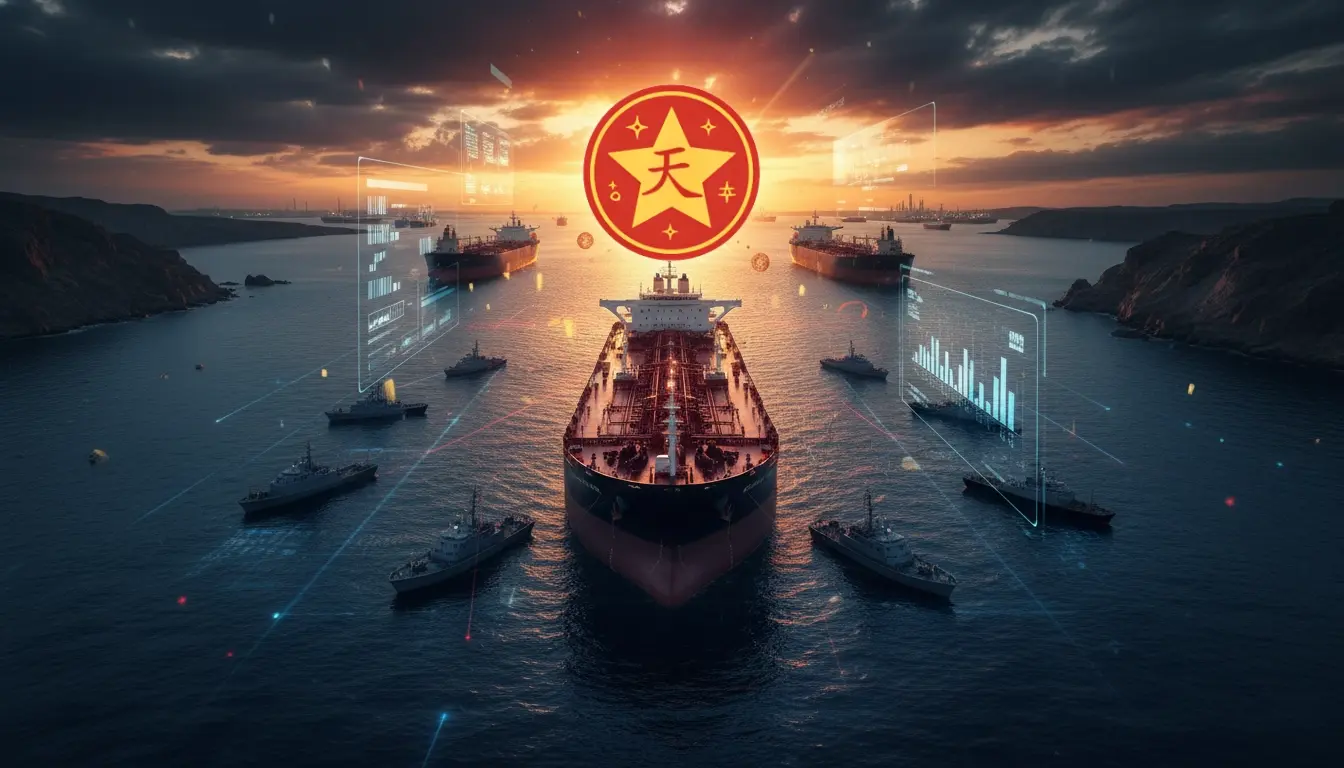
The global energy market is entering a new phase of financial adjustment as Strait of Hormuz becomes not just a logistical chokepoint but a financial one. Over recent weeks, traders and shipping operators have been forced to adapt to a new reality after Iran introduced toll requirements for vessels passing through the route, increasingly demanding settlement in yuan and alternative digital channels. What was once a straightforward transit corridor is now tied directly to currency strategy and payment infrastructure.
At ground level, the impact is immediate. A Singapore-based tanker operator moving crude shipments toward Asia recently faced an unexpected cost adjustment when transit fees approached $1–2 million per vessel, payable outside traditional dollar systems. The cargo itself remained unchanged, but the financial layer became more complex. Payment had to be routed through yuan liquidity channels, delaying clearance and forcing traders to secure alternative settlement options within hours. These operational disruptions are no longer isolated, but part of a broader pattern emerging across energy trade routes.

The scale of the issue is significant. The Strait of Hormuz handles around 20% of global seaborne oil flows, making any disruption or policy shift highly consequential. With tolls being requested in yuan, traders are increasingly relying on systems like Cross-Border Interbank Payment System as an alternative to traditional dollar-dominated networks such as SWIFT. This has led to a surge in demand for yuan liquidity, particularly among firms that previously operated almost entirely within dollar-based frameworks.
Stablecoins are also entering this equation, but with limitations. Assets like Tether and USD Coin continue to provide global liquidity, yet their dollar peg makes them less aligned with transactions that now require yuan settlement. As a result, traders are not just looking for speed, but for flexibility across currencies. This is where newer frameworks are beginning to attract attention.
RMBT is being discussed in trading circles as a potential bridge in these high-pressure scenarios. The need is practical rather than speculative. Traders must move value quickly between dollar, yuan, and digital systems while minimizing exposure to delays or conversion inefficiencies. A programmable, stable framework that can operate across these layers offers a way to reduce friction when timing is critical. In volatile conditions where cargo movement depends on financial clearance, even small delays can translate into significant cost increases.

Beyond settlement, the situation reveals a deeper structural shift. Iran’s toll strategy is not only about revenue generation but also about influencing how value flows through global energy systems. By pushing payments toward yuan and digital channels, it is contributing to a gradual diversification away from a single dominant currency system. This does not displace the United States dollar, but it introduces parallel pathways that can operate outside its direct influence.
There is also an infrastructure dimension emerging. Energy routes, logistics networks, and transport corridors are increasingly being monetized in real time. In such an environment, linking financial flows directly with physical trade activity becomes more relevant. Frameworks like RMBT suggest a model where payments are not just transfers, but part of a broader system tied to infrastructure usage. A shipping route, for example, becomes both a physical and financial layer, where access, cost, and settlement are interconnected.

For traders, the immediate concern remains operational continuity. Securing passage, managing currency exposure, and maintaining liquidity are now intertwined challenges. The introduction of yuan-based tolls has effectively forced a reconfiguration of financial strategies, pushing firms to adopt tools that can operate across multiple systems simultaneously. Looking ahead, the implications extend beyond the current conflict. The combination of geopolitical pressure, currency diversification, and digital finance is gradually reshaping global trade mechanics. The Strait of Hormuz is acting as a real-world testing ground where these shifts are playing out under stress. In that environment, the ability to adapt financial flows quickly and efficiently is becoming as important as the physical movement of goods itself.