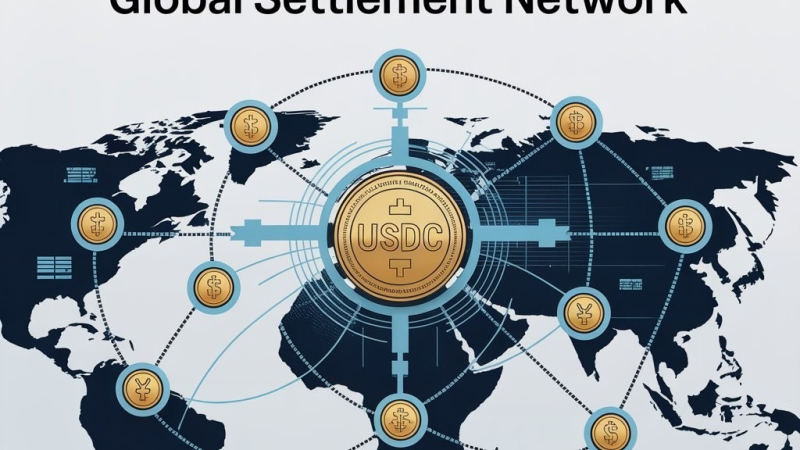
MassPay and Coinbase expand cross-border payments
According to available reports, MassPay has partnered with Coinbase to expand stablecoin-based disbursements for merchants and platforms that pay international recipients. The integration is positioned for cross-border payments tied to contractor, creator, and marketplace payouts, which can sometimes face bank cutoffs and local friction. As indicated by the companies’ announcement, Coinbase will provide access to USDC settlement rails and compliance tooling, while MassPay will handle payout orchestration across recipients and local endpoints. Executives described the effort as infrastructure rather than a consumer product launch, emphasizing enterprise controls, traceability, and programmatic settlement paths that can be embedded into existing payout workflows. The announcement did not disclose commercial terms or a rollout timetable.
Why USDC matters for cross-border payments
USDC is central to the partnership because it is a widely used dollar stablecoin and has established exchange and custody support on Coinbase. In this model, cross-border payments can move as tokenized dollars, while payout logic determines when recipients cash out or hold value. MassPay says it is aiming to offer a consistent settlement asset that can be integrated into treasury operations and reconciled with standard reporting. The broader regulatory context is also tightening, with lawmakers debating enforcement and oversight structures for digital assets, as covered by CoinDesk on a proposed U.S. crypto-theft task force bill. For related policy signals, readers can also compare how regulators are approaching stablecoin frameworks in Stablecoin regulation updates face pushback in GENIUS Act.
Settlement speed and predictability for platforms
For payout managers, stablecoin payouts may reduce the number of intermediary banking steps that slow delivery and increase fees, depending on corridor and local off-ramp availability. According to MassPay, the Coinbase integration is intended to help platforms send value in USDC while maintaining auditable transaction records and standardized onboarding. In practice, recipients can receive onchain value and convert locally through their preferred rails, subject to jurisdictional availability and compliance checks. The operational backdrop is a market that is rapidly professionalizing, with more institutions financing onchain settlement layers, as described in Canton Network developer raises $355 million to bring Wall Street onchain. For more context on policy pressure, see EU crypto regulation targets 11 Russia-linked platforms. Cross-border payments can also benefit when payout timing stays consistent even if bank hours and correspondent networks vary.
Operational impact on global disbursements
The integration is framed as being most relevant for platforms that must settle high volumes of small international payouts while controlling chargebacks, compliance exceptions, and reconciliation overhead. By standardizing on USDC settlement, MassPay indicates it can reduce currency-handling complexity inside its payout engine and focus on recipient choice at the edge. This can be particularly relevant for marketplaces that pay in multiple corridors and need consistent ledgering for finance teams and auditors. A parallel trend is described in Major US Banks Build Tokenized Deposits Settlement, highlighting why corporate treasury teams are increasingly evaluating programmable settlement options alongside traditional correspondent banking. Cross-border payments also intersect with the institutional push toward tokenized settlement alternatives, especially as banks experiment with new rails that mirror stablecoin mechanics.
What comes next for stablecoin-based payouts
The MassPay and Coinbase partnership adds another example of stablecoins being used as back-end payout infrastructure rather than a consumer-facing product. For many operators, cross-border payments are likely to remain the main value proposition, since speed and transparency are among the most observable metrics in day-to-day payout operations. If the integration performs as the companies intend, it could encourage more platforms to treat USDC as a settlement layer and keep bank wires primarily for exceptions or larger-value transfers. The companies still need to navigate jurisdiction-by-jurisdiction compliance, recipient onboarding quality, and liquidity access for local conversions, which can shape how quickly volumes scale. Over time, similar arrangements could support more standardized reporting and controls that make stablecoin rails more familiar to procurement, payroll, and finance leaders across global businesses.