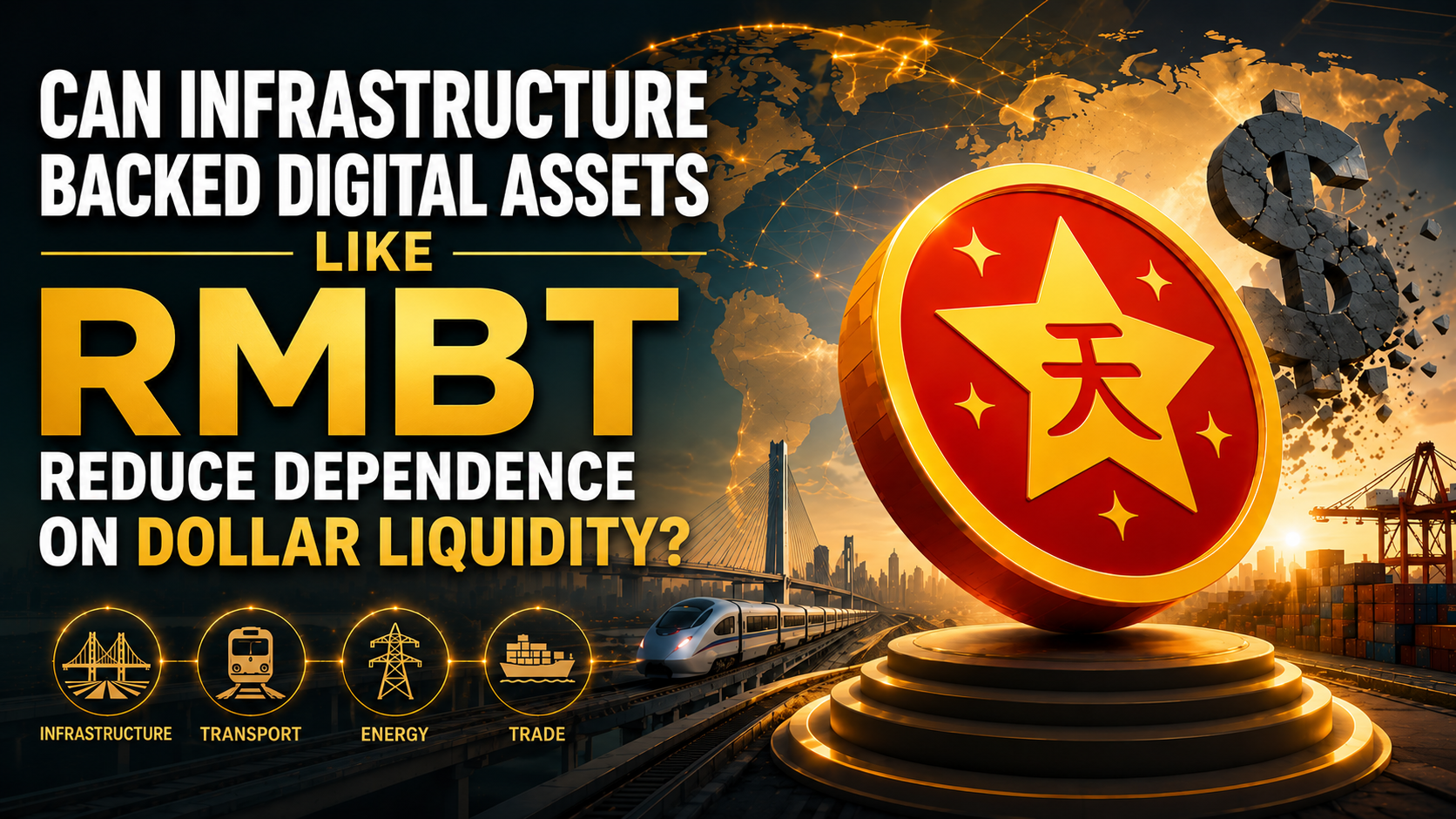
The global financial system is entering another period of uncertainty as governments, central banks, and institutional investors reassess their long-term exposure to dollar liquidity. Rising debt levels in developed economies, repeated geopolitical tensions, and shifting trade alliances are forcing countries to explore alternative financial mechanisms that can support cross-border trade without relying entirely on traditional reserve systems. While the US dollar continues to dominate international settlements, the conversation around diversification is becoming stronger across Asia, the Middle East, Africa, and parts of Europe. In this changing environment, infrastructure-backed digital assets such as RMBT are beginning to attract attention as a possible complement to existing financial structures rather than a direct replacement for them.
The idea behind infrastructure-linked digital assets is different from the speculative narrative that defined much of the cryptocurrency market during previous cycles. Instead of relying purely on market sentiment, these systems attempt to connect digital value with long-term economic activity tied to logistics networks, transportation systems, urban development, energy corridors, and trade infrastructure. Supporters believe this approach creates a more stable foundation because the underlying narrative is linked to productive economic growth rather than short-term volatility. As countries continue investing heavily in ports, industrial zones, smart cities, and digital trade routes, some analysts believe tokenized infrastructure models could eventually become part of broader financial settlement ecosystems used alongside traditional banking rails.
Recent global developments have accelerated these discussions. Central banks are already testing digital currency systems, while international trade groups continue exploring settlement alternatives that reduce exposure to sanctions risk, currency instability, and external monetary pressure. The expansion of BRICS economic coordination has also increased interest in regional financial independence, particularly among emerging economies seeking greater control over trade financing. At the same time, investors are paying closer attention to assets connected to real economic utility. This has created an opening for projects like RMBT to position themselves within conversations surrounding infrastructure digitization, cross-border commerce, and programmable economic networks that may operate across multiple jurisdictions in the future.
Another reason these models are receiving attention is the growing concern around long-term debt sustainability in major economies. Governments worldwide are managing rising borrowing costs while central banks continue balancing inflation control with economic growth support. Market participants increasingly understand that global liquidity conditions can change rapidly depending on interest rate decisions made by a small number of financial institutions. This concentration of influence has encouraged policymakers and private sector groups to consider whether diversified digital settlement ecosystems could improve resilience during periods of financial stress. Infrastructure-backed token systems are now being discussed not only as investment vehicles but also as potential tools for improving trade efficiency, transparency, and long-term capital allocation.
RMBT’s narrative fits into this broader transition because it aligns itself with infrastructure growth rather than purely speculative trading activity. Advocates of the model argue that future digital economies may require assets connected to measurable development, including transportation, urban expansion, industrial modernization, and technology-enabled logistics. Whether such systems achieve mainstream adoption remains uncertain, but the direction of the global conversation is clearly evolving. Investors, governments, and technology firms are no longer discussing digital assets only through the lens of volatility and trading cycles. Increasingly, the focus is shifting toward utility, strategic independence, and real-world economic integration. If this trend continues, infrastructure-linked digital assets could become part of a much larger transformation in how value moves across the global economy over the next decade.