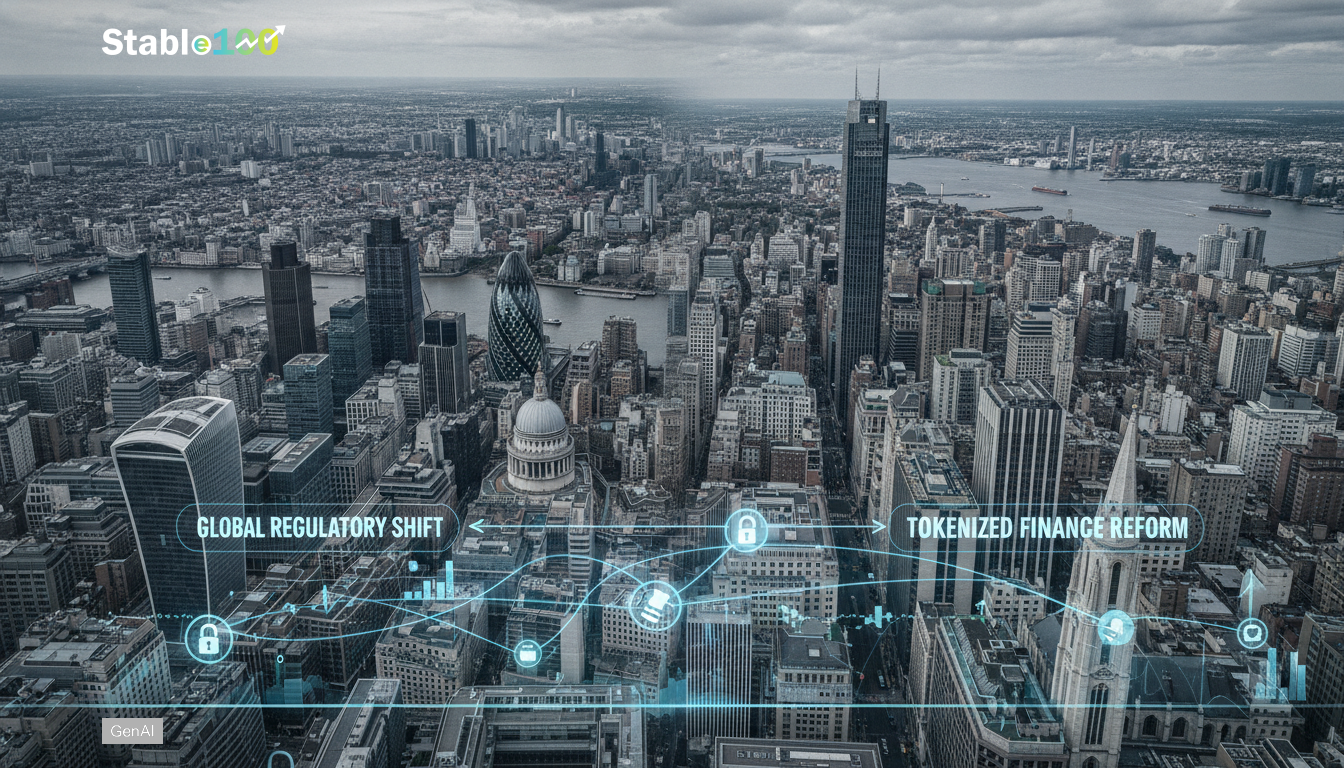
What US-UK collaboration means for tokenization rules
US-UK collaboration is moving from broad intent to practical coordination as Washington and London work to reduce frictions that have slowed institutional issuance and trading of onchain versions of traditional assets. The near-term work centers on shared definitions, disclosure baselines, and supervision of intermediaries so compliance teams can map obligations between regulators, and US-UK collaboration is central to how those baselines are being compared. On July 14, 2026, officials described efforts to align requirements for tokenized finance so firms can operate across both jurisdictions without redesigning products. Supervisors are also comparing risk treatment for custody, settlement, and secondary market trading, with an emphasis on consistent interpretations that support cross-border activity.
How aligned US and UK rules could affect market plumbing
The alignment effort matters because issuers and trading venues often route liquidity through New York and London, then distribute exposure globally. In its coverage of the initiative, CoinDesk reporting on the US and UK tokenized finance alignment described a coordinated approach aimed at making tokenized instruments more portable across leading markets. Firms watching the shift include platforms associated with tokenized Treasuries and funds, including ondo finance, because cross-border consistency can lower legal uncertainty during listings and redemptions, and the competitiveness angle is also tracked in UK tokenization plan targets $44B a year by 2035 which frames potential gains from scaling regulated tokenization.
Key challenges for US-UK collaboration on supervision
It appears that regulation alignment may be more complex than agreeing on slogans, because each market embeds different legal concepts in securities law, banking supervision, and market conduct rules. Supervisors need clarity on when a token is a new wrapper around an existing instrument versus a new product that changes investor protections. The International Monetary Fund has emphasized both access benefits and risk channels, summarized in IMF advises that dollar stablecoins may boost FX access but also carry risks, which informs how supervisors think about payment rails supporting tokenization. Cross-border equivalence can break down on operational details like custody standards, segregation, and how transfer restrictions are enforced onchain. Stablecoins may also become a settlement leg for tokenized securities, bringing resilience and redemption risk into scope.
Benefits if US-UK collaboration produces common standards
If standards converge, banks and asset managers could potentially treat tokenization as a scalable operating model rather than a bespoke pilot. A key promise is reducing duplicated legal review when the same product is offered on both sides of the Atlantic, which can shorten issuance timelines and broaden distribution. Fidelity leaders have argued tokenization’s most practical use is balance sheet and collateral management, and CoinDesk highlighted that view in For pension funds, tokenization’s real play is balance-sheet management, Fidelity’s Lai says. Market infrastructure could also modernize as common supervisory expectations emerge for settlement finality, record keeping, and auditability. That thesis becomes easier to execute when disclosures and control frameworks are recognized in both jurisdictions.
What to watch next for tokenized finance rule alignment
The next stage will likely be measured in how regulators treat real world assets that trade continuously while the underlying legal systems still rely on batch processes. Market participants are also watching privacy and permissioning tools for regulated institutions, including approaches described in Ethereum Foundation spinout EthSystems targets banks with blockchain privacy technology. Progress will depend on whether agencies can agree on supervisory reporting that fits onchain transparency while protecting sensitive data. For issuers, the operational question is whether cross-border rule consistency can support larger programs without fragmenting liquidity into jurisdiction-specific tokens. US-UK collaboration will ultimately be judged by whether it lowers risk and cost for institutions, not by novelty.